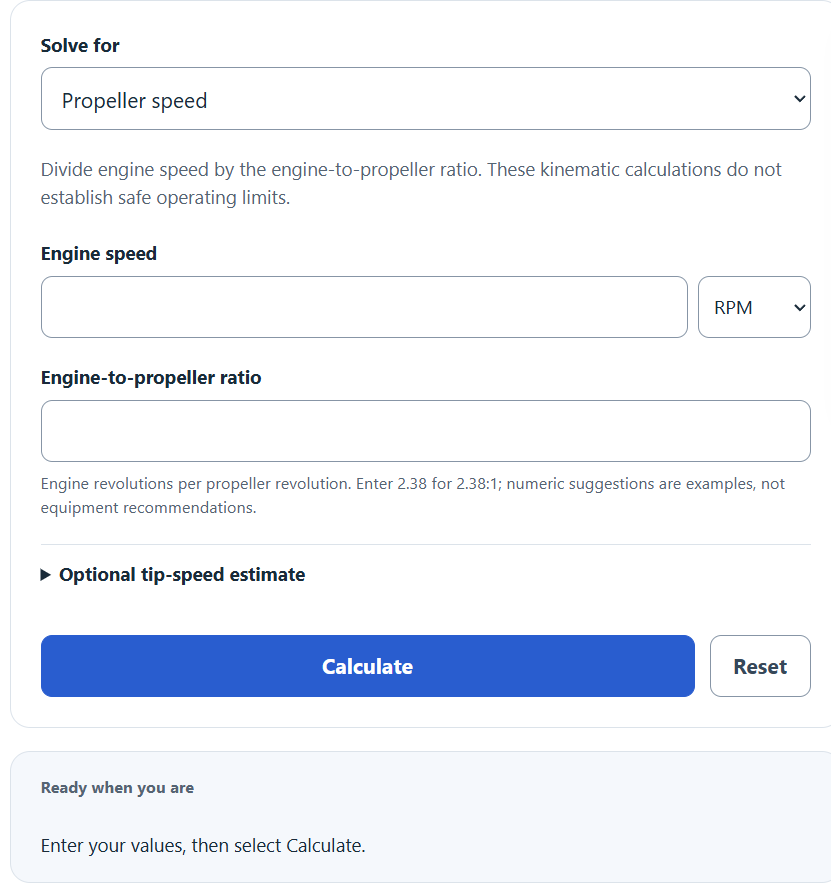
Calculate airboat prop speed, required gear reduction, and RPM at a chosen tip-speed ceiling from engine speed in RPM or rad/s, prop diameter, and tip speed limit.
- Final Drive Ratio Calculator
- Sprocket Ratio Calculator
- All Physics Calculators
- Piston Speed Calculator (mean)
- Boat Fuel Consumption Calculator
Airboat Prop Speed Formula
Select a quantity under Solve for, enter its displayed inputs, then select Calculate. The calculator uses three formulas, one per mode.
Prop speed mode:
Gear ratio mode:
RPM at a chosen tip-speed ceiling:
- Engine RPM — crankshaft speed of the engine.
- Prop RPM — rotational speed of the propeller after the gearbox.
- Ratio — gearbox reduction, expressed as engine:prop (e.g. 2.38:1).
- D — prop diameter in feet (the calculator converts in, cm, and m).
- Tip Speed — linear speed of the blade tip, in ft/s.
Assumptions: the gearbox is a simple reduction with no slip, prop and engine share the same drive (no clutch slip during steady operation), and tip speed is calculated from rotation only (forward speed and induced airflow are omitted; this is not a complete operating-limit analysis). The Mach value uses a fixed approximate speed of sound of 1,125 ft/s; actual sound speed depends on conditions.
Typical Values and Tip Speed Reference
Illustrative ratios and RPM arithmetic; these examples do not recommend a gearbox or propeller combination:
| Ratio | Drive relationship | Prop RPM at 5,200 engine RPM |
|---|---|---|
| 1.00:1 | Direct drive | 5,200 |
| 1.38:1 | Reduction | 3,768 |
| 1.68:1 | Reduction | 3,095 |
| 2.00:1 | Reduction | 2,600 |
| 2.38:1 | Reduction | 2,185 |
| 2.55:1 / 2.68:1 | Reduction | 2,040 / 1,940 |
Approximate rotational Mach reference at 1,125 ft/s sound speed. These bands are not safety, noise or efficiency ratings; follow the exact propeller manufacturer’s limits.
| Tip speed (ft/s) | Approx. Mach | Notes |
|---|---|---|
| Under 750 | <0.67 | No safety or loading conclusion from tip speed alone. |
| 750-850 | 0.67-0.76 | Noise depends on propeller design and operating conditions. |
| 850-950 | 0.76-0.84 | Verify the exact propeller rating. |
| Over 950 | 0.84+ | Approaching transonic; verify prop rating. |
Worked Example and FAQ
Example. Engine at 5,200 RPM, 2.38:1 reduction, 78 in prop.
- Prop RPM = 5,200 / 2.38 ≈ 2,184.874 RPM
- Diameter = 78 / 12 = 6.5 ft
- Tip speed = pi × 6.5 × (5,200 / 2.38) / 60 ≈ 743.598 ft/s (about Mach 0.66)
This is a rotational tip-speed estimate, not approval to operate that propeller or drive combination.
Why does tip speed matter more than prop RPM alone? A 60 in prop at 3,000 RPM and an 84 in prop at 2,140 RPM both spin at very different RPM but produce nearly the same tip speed. Tip speed helps describe the operating condition, but noise, efficiency and structural limits also depend on the propeller design, RPM and loading.
Should I size for peak engine RPM or cruise RPM? Check the full operating range against the propeller and drive manufacturer’s RPM, power and installation limits. A chosen tip-speed ceiling alone does not establish a safe reduction ratio.
Can I run direct drive? Direct-drive suitability depends on the exact propeller and engine ratings. A 60 in prop at 5,200 RPM gives a rotational tip speed near 1,361 ft/s, about Mach 1.21 using the stated sound-speed assumption. Do not use this calculation as manufacturer approval.