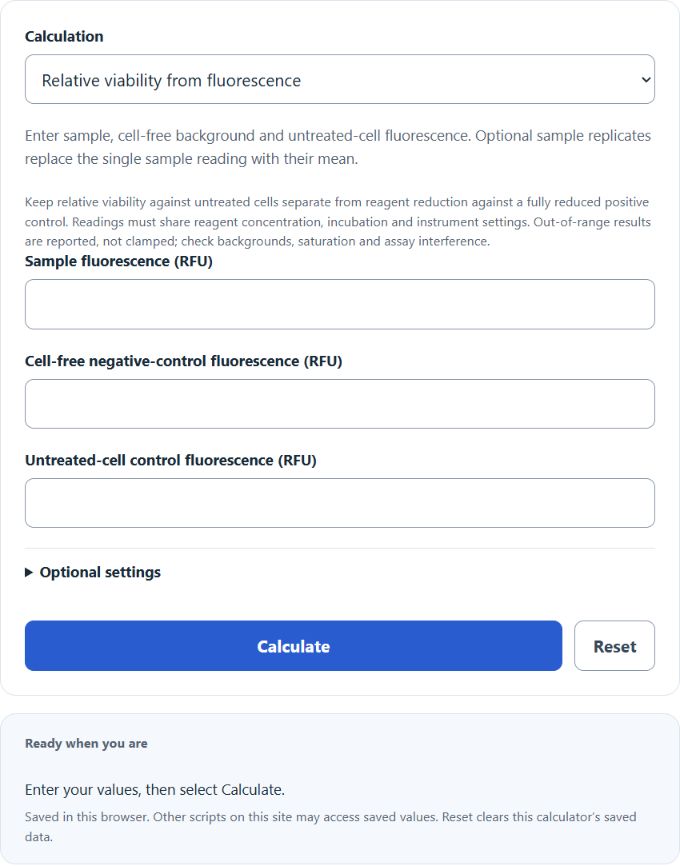
Calculate blank-corrected relative cell viability or method-specific percent alamarBlue reagent reduction. Choose the result your control design supports: an untreated-cell control and a fully reduced reagent control serve different purposes.
Choose the appropriate method
Relative viability = 100 × (sample RFU − blank RFU) / (untreated-control RFU − blank RFU). This expresses signal relative to untreated cells; it is not the percentage of reagent reduced. Optional sample replicates replace the sample reading with their mean.
Fluorescence reduction = 100 × (sample RFU − blank RFU) / (100%-reduced-control RFU − blank RFU).
For paired absorbance, reduction = 100 × (Eox,2A₁ − Eox,1A₂) / (Ered,1C₂ − Ered,2C₁). A values are test absorbances; C values are cell-free medium-plus-reagent negative controls. Do not pre-subtract C from A.
| Wavelengths (nm) | Eox₁ | Eox₂ | Ered₁ | Ered₂ |
|---|---|---|---|---|
| 570 / 600 | 80586 | 117216 | 155677 | 14652 |
| 570 / 630 | 80586 | 34798 | 155677 | 5494 |
| 540 / 600 | 47619 | 117216 | 104395 | 14652 |
Worked example
Sample 600 RFU, blank 100 RFU and untreated control 1,100 RFU give 100 × 500 / 1,000 = 50% relative viability. If the fully reduced reagent control is instead 2,100 RFU, the reduction result is 100 × 500 / 2,000 = 25%.
Frequently asked questions
Why can results exceed 100%?
A stronger signal than the reference gives a value above 100%. The calculator keeps it visible; check background, interference and assay range.
What does the replicate SD describe?
Sample variability only. The control and blank are treated as fixed, so it is not a confidence interval or total assay uncertainty.
Can fluorescence be converted to absorbance?
Not with a universal factor. Use the measurement protocol and its required controls.
Reference: Thermo Fisher alamarBlue user guide, fluorescence and paired-absorbance calculations.