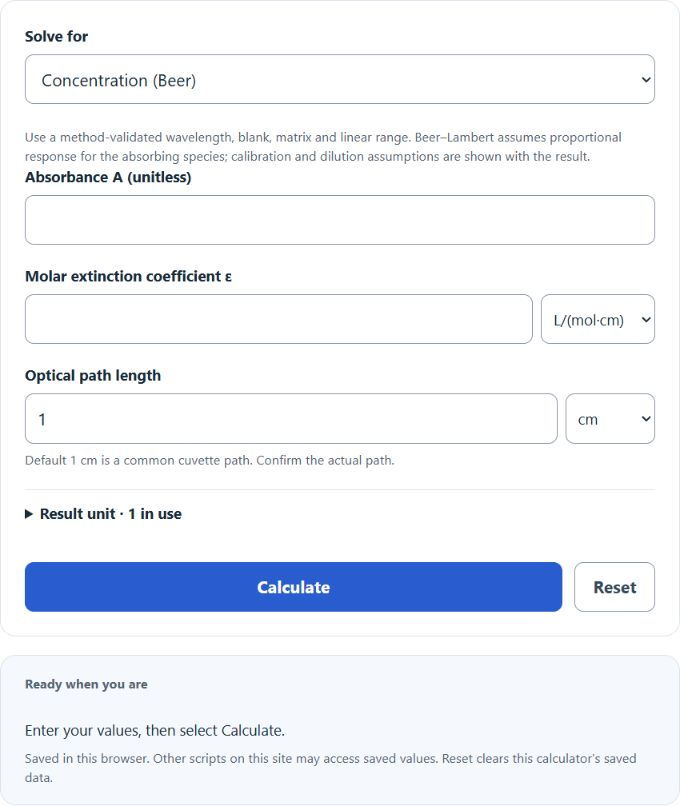
Calculate molar concentration, absorbance, extinction coefficient or optical path using Beer–Lambert law; use linear-fit coefficients or blank-corrected absorbance ratios for the separate calibration and preparation modes.
- All Chemistry Calculators
- Delta Absorbance Per Minute Calculator
- Extinction Coefficient Calculator
- Absorbance to Transmittance Calculator
- Percent Transmittance to Absorbance Calculator
- Molarity Calculator
- Solution Strength Calculator
Concentration from Absorbance Formula
The following formula is used to calculate a concentration from absorbance.
- Where A is the absorbance
- L is the path length
- e is the extinction coefficient
To calculate the concentration from absorbance, divide the absorbance by the product of the path length and extinction coefficient.
Concentration Definition
Molar concentration is the amount of a specified substance per solution volume, commonly expressed in mol/L. Use a species- and wavelength-specific molar coefficient and a method-validated blank, matrix and linear range.
Concentration from Absorbance Example
How to calculate concentration from absorbance?
- First, determine the absorbance.
Calculate the absorbance.
- Next, determine the path length.
Use the optical path length through the sample and its matching unit.
- Next, determine the extinction coefficient.
Use a verified molar coefficient for the species, wavelength and conditions.
- Finally, calculate the concentration.
Calculate the concentration using the equation above.
FAQ
Here, concentration means moles of the specified substance per solution volume.