Calculate absorbance, transmittance, and % light passing through a sample from Beer-Lambert inputs or intensity readings, with AU and %T outputs.
- All Chemistry Calculators
- Concentration from Absorbance Calculator
- Delta Absorbance per Minute Calculator
- Percent Transmittance to Absorbance Calculator
- Extinction Coefficient Calculator
- Rate of Reaction Calculator
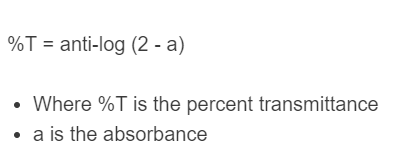
Absorbance to Transmittance Formula
- A = absorbance (AU, unitless)
- T = transmittance as a decimal fraction (0 to 1)
- %T = transmittance as a percentage (0 to 100)
The reverse direction uses A = -log₁₀(T). If you only have raw light readings, T = I/I₀ where I is the transmitted intensity and I₀ is the reference. To predict A from sample properties, the calculator applies the Beer-Lambert law A = εlc, then converts to %T. Path length is converted to cm and concentration to mol/L before multiplying.
Reference Tables
Quick conversions between absorbance and transmittance:
| Absorbance (A) | Transmittance (%T) | Light blocked |
|---|---|---|
| 0.00 | 100% | 0% |
| 0.10 | 79.4% | 20.6% |
| 0.30 | 50.1% | 49.9% |
| 0.50 | 31.6% | 68.4% |
| 1.00 | 10.0% | 90.0% |
| 1.50 | 3.16% | 96.84% |
| 2.00 | 1.00% | 99.00% |
| 3.00 | 0.10% | 99.90% |
How to interpret a reading:
| Range | What it means |
|---|---|
| A < 0.1 | Low absorbance; usable sensitivity depends on the method. |
| A 0.1 to 1.0 | Often useful, but validate the instrument and method’s linear range. |
| A 1.0 to 2.0 | Low transmittance; check the instrument and method’s validated range. |
| A > 2.0 | Very low transmittance; stray light and detector limits can affect accuracy. |
| Negative A | Sample reading exceeds reference; rerun the blank. |
Worked Example and FAQ
Example. A sample reads A = 0.75 at 540 nm. Then T = 10⁻⁰·⁷⁵ = 0.1778, so %T = 17.78%. About 17.78% of the incident light passes through; the rest is not transmitted and may be absorbed, scattered, or reflected.
Why is absorbance unitless? It is the log ratio of two intensities (I₀/I), so the units cancel. The “AU” label just marks that it came from an absorbance measurement.
Can transmittance exceed 100%? Not for a true absorbing sample. A %T above 100 means the reference reading was lower than the sample reading, usually a blanking error or a fluorescent sample.
Which calculation should I use? Use Absorbance → %T or %T → Absorbance for direct conversion. Use Beer-Lambert when you know ε, path length, and concentration. Use Light readings when you have raw I and I₀ from a detector.