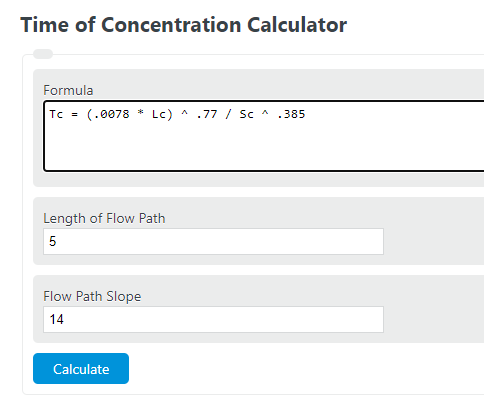
Calculate Kirpich time of concentration, solve for flow-path length or average slope, and switch between metric and US customary drainage units.
- All Construction Calculators
- Water Flow Rate Calculator
- Volumetric Flow Rate Calculator
- GPM (gallons/min) Calculator
- Time of Concentration Calculator
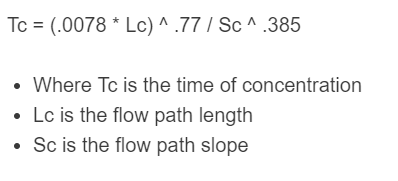
Time of Concentration Formula
The time of concentration is the estimated travel time for runoff to move from the hydraulically most distant point in a drainage area to its outlet. This calculator uses the Kirpich equation, which is commonly applied to small watersheds with a reasonably well-defined flow path.
In this form, the result is in minutes when the flow path length is in feet and the slope is entered as a decimal. If you are working in metric units, the equivalent form is:
Slope must be entered as a ratio rather than a percent. That means a 2% slope should be entered as 0.02.
Variable Guide
| Variable | Description | Practical Meaning |
|---|---|---|
| Tc | Time of concentration | The runoff travel time from the most distant contributing point to the outlet. |
| L | Flow path length | The longest hydraulically connected path that runoff follows, not the straight-line map distance. |
| S | Flow path slope | The average slope of the flow path, entered as a decimal ratio. |
How to Use the Calculator
- Identify the watershed outlet or discharge point.
- Trace the longest runoff path from the hydraulically most distant point to that outlet.
- Measure the total flow path length along that route.
- Determine the average slope of the path using elevation change divided by horizontal distance.
- Convert percent slope to decimal form before entering it.
- Enter the known values and calculate the missing variable.
Because the calculator can solve for any one missing value, it is useful both for direct estimation and for checking design assumptions during preliminary drainage analysis.
Example
Suppose a drainage path is 500 feet long and has a 2% average slope. First convert the slope from percent to decimal, then apply the equation.
This result means runoff from the farthest contributing point would be expected to reach the outlet in a little over four minutes. In general, shorter times of concentration indicate a faster watershed response and a greater tendency toward earlier peak runoff.
Why Time of Concentration Matters
- Helps estimate how quickly a drainage area responds to rainfall.
- Supports stormwater design decisions for ditches, culverts, channels, and inlets.
- Improves peak runoff analysis by tying rainfall duration to watershed response time.
- Provides a fast screening value when comparing alternative site layouts or grading plans.
- Helps identify whether a basin behaves as a flashy system or a slower-draining one.
When the Kirpich Method Works Best
The Kirpich relationship is most appropriate when the drainage area is relatively small, the runoff path is reasonably well defined, and the watershed behaves more like a natural or lightly developed drainage system than a highly engineered urban network.
- Small drainage areas
- Rural or lightly developed sites
- Defined swales, ditches, or channelized flow paths
- Sites where average slope can be estimated with reasonable confidence
Use extra caution when the site includes extensive sheet flow, pavement, storm sewer routing, detention structures, or very flat terrain. In those conditions, a segmented travel-time approach may better represent actual runoff behavior.
Solving for Another Variable
If time of concentration is already known and you need to estimate the missing flow path length or slope, the equation can be rearranged. The forms below correspond to the feet-based version of the equation.
If you are using meters instead of feet, use the metric coefficient from the earlier formula.
Common Input Mistakes
- Entering slope as a whole-number percent instead of a decimal ratio.
- Using straight-line distance instead of the actual runoff travel path.
- Mixing units without converting them first.
- Using a zero or negative slope value.
- Applying the Kirpich equation to highly urbanized or heavily routed systems without checking whether a different method is more suitable.
FAQ
What does a smaller time of concentration mean?
A smaller value means runoff reaches the outlet more quickly. Faster response usually means less storage in the watershed and a sharper runoff peak during storms.
Is time of concentration the same as total travel time?
For practical drainage calculations, it is the travel time from the most distant hydraulically connected point to the outlet. In more detailed hydrology work, total travel time may be broken into separate segments such as sheet flow, shallow concentrated flow, and channel flow.
Can I use percent slope directly?
No. Percent slope should be converted to decimal form before calculation. For example, 5% becomes 0.05.
What if my site has several different flow segments?
If runoff moves through distinctly different surfaces or conveyance types, a segmented method is often more representative than treating the entire path as one uniform reach.