Calculate extinction coefficient (ε) from a protein or DNA/RNA sequence, or solve absorbance, concentration, and path length using the Beer-Lambert law.
- All Chemistry Calculators
- Molarity Calculator
- Concentration from Absorbance Calculator
- Absorbance to Transmittance Calculator
- Percent Transmittance to Absorbance Calculator
Extinction Coefficient Formula
The calculator uses one of two formulas depending on the input mode.
From protein sequence (Pace/Edelhoch method, 280 nm):
- ε = molar extinction coefficient at 280 nm (M⁻¹ cm⁻¹)
- nW = number of tryptophan residues
- nY = number of tyrosine residues
- nC-C = number of cystine (disulfide) bonds; 0 if cysteines are reduced
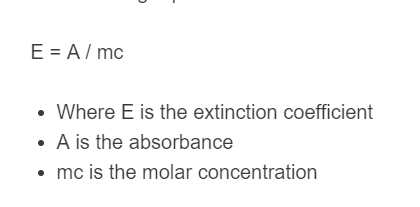
From absorbance (Beer–Lambert law):
- A = absorbance (unitless)
- c = molar concentration (M)
- l = path length (cm)
- ε = molar extinction coefficient (M⁻¹ cm⁻¹)
The sequence method assumes the protein is folded in water at neutral pH and that absorbance at 280 nm comes from Trp, Tyr, and disulfides. Free cysteines contribute nothing. Phe is ignored. Expect roughly ±5% error versus measured values; proteins with no Trp can deviate more.
Reference Values
Per-residue contributions used in the sequence calculation:
| Group | ε at 280 nm (M⁻¹ cm⁻¹) |
|---|---|
| Tryptophan (W) | 5,500 |
| Tyrosine (Y) | 1,490 |
| Cystine (disulfide) | 125 |
| Free cysteine (-SH) | 0 |
Typical ε values for common proteins, useful as a sanity check:
| Protein | MW (Da) | ε (M⁻¹ cm⁻¹) | A (1 mg/mL) |
|---|---|---|---|
| BSA | 66,400 | 43,824 | 0.66 |
| IgG (typical) | 150,000 | 210,000 | 1.40 |
| Lysozyme | 14,300 | 38,940 | 2.72 |
| Insulin | 5,808 | 5,840 | 1.01 |
| GFP | 26,900 | 22,000 | 0.82 |
Worked Example
Sequence input: a 100-residue protein with 2 Trp, 5 Tyr, and 4 Cys assumed all oxidized (2 disulfides).
ε = (2 × 5500) + (5 × 1490) + (2 × 125)
ε = 11,000 + 7,450 + 250
ε = 18,700 M⁻¹ cm⁻¹
Beer–Lambert input: A₂₈₀ = 0.85, c = 0.1 mM, l = 1 cm.
ε = 0.85 / (1 × 10⁻⁴ × 1) = 8,500 M⁻¹ cm⁻¹
FAQ
Reduced or oxidized cysteines? Use oxidized for secreted or extracellular proteins (most antibodies, serum proteins). Use reduced for cytoplasmic proteins or samples in reducing buffer (DTT, TCEP, β-ME).
Why does my measured ε differ from the predicted value? Aggregation, scattering, bound cofactors, denaturation, or unusual local environments around aromatic residues all shift A₂₈₀. Measure ε in 6 M guanidine HCl for the closest match to the calculated value.
Can I use this for nucleic acids? No. The sequence formula is calibrated for proteins. For DNA or RNA, use nearest-neighbor methods at 260 nm.
What if my protein has no Trp or Tyr? A₂₈₀ will be very low and unreliable. Use a colorimetric assay (BCA, Bradford) or measure at 205 nm instead.