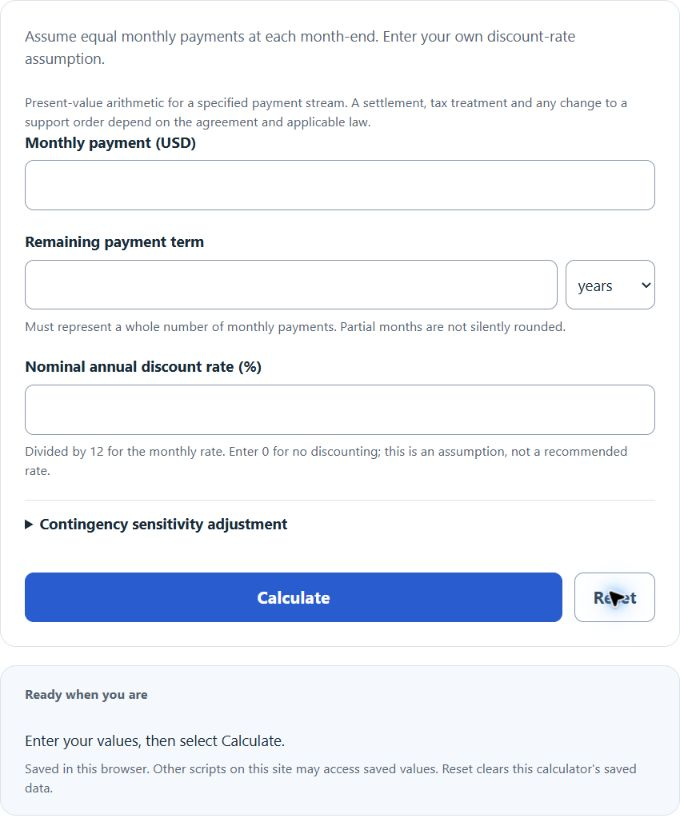
Estimate the present value of remaining monthly alimony payments with a discount rate and optional contingency adjustment.
Related Calculators
- Rent-Stabilized Buyout Calculator
- Mortgage Buydown Calculator
- 2/1 Buydown Calculator
- Inflation Depreciation Calculator
- All Personal Finance Calculators
Alimony Buyout Formula
This ordinary-annuity equation estimates the present value of equal monthly payments made at each month-end. It does not determine a legally required settlement.
- Where ABO is the present value before the contingency adjustment ($)
- A is the monthly alimony payment ($)
- r is the monthly discount rate: nominal annual percentage divided by 1200
- n is the whole number of monthly payments; years are multiplied by 12
Multiply the monthly payment by [1 − (1 + r)^−n] / r. When r = 0, use payment × n. The optional contingency factor scales this value; it does not replace a period-by-period probability model. An effective annual rate requires conversion and is not the nominal annual input used here.
What is an Alimony Buyout?
Definition:
An alimony buyout is a proposed lump-sum settlement in place of specified future support payments. Whether an agreement changes or ends an obligation depends on its terms, applicable law and any required court approval. This calculator values an assumed payment stream; it does not establish legal finality.
How to Calculate Alimony Buyout?
Example Problem:
The following example outlines the steps and information needed to calculate the Alimony Buyout.
First, enter a monthly payment of $1,000.
Use an illustrative nominal annual discount rate of 5%, giving a monthly rate of 0.05 ÷ 12. This rate is an assumption, not a recommendation.
Enter 3 years, or 36 month-end payments, with contingency factor 1.
Finally, calculate the Alimony Buyout using the formula above:
PV = 1,000 × [1 − (1 + 0.05/12)−36] ÷ (0.05/12)
PV ≈ 1,000 × 33.36570128
PV ≈ $33,365.70, compared with $36,000 of undiscounted payments.
FAQ
What are the advantages of an alimony buyout?
A properly documented settlement may exchange specified future payments for a lump sum. Whether it ends an obligation or changes enforcement rights depends on the agreement, law and any required court approval.
Should I always opt for an alimony buyout?
Not necessarily. Whether a buyout is beneficial depends on factors such as financial stability, tax implications, and future plans. Individuals should consult financial or legal professionals to determine if a buyout is right for them.
Does the discount rate affect the fairness of the buyout?
For a fixed nonnegative payment stream, a higher discount rate reduces its calculated present value. Selecting a rate involves assumptions about timing, risk and alternatives; this arithmetic alone does not establish fairness.