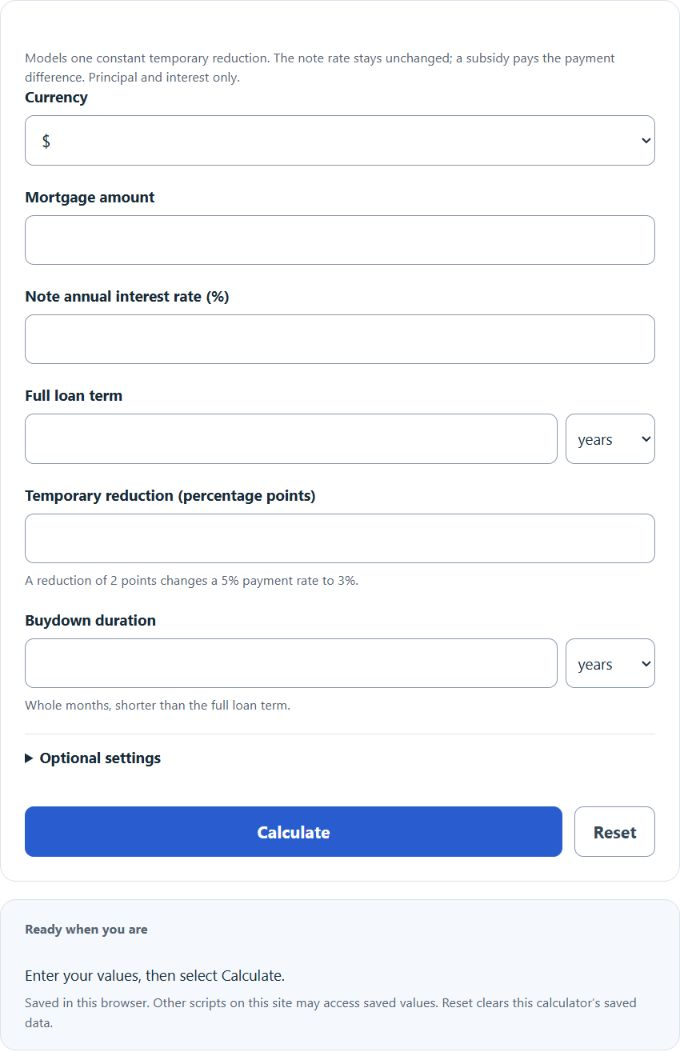
Estimate payments, payment reductions and the subsidy for one constant temporary mortgage buydown reduction. This calculator does not model a stepped 2–1 or 3–2–1 schedule.
Mortgage Buydown Formula
The following equation is used to calculate the borrower’s monthly principal-and-interest payment amount during a temporary buydown period (i.e., the payment you make when the payment is set using a reduced rate):
- Where Mbuydown is the borrower’s monthly principal-and-interest payment amount during the buydown period ($/month)
- P is the principal (loan amount) ($)
- rb is the monthly interest rate used to set the reduced payment, as a decimal (rb = (i − Δi)/12, where i and Δi are annual rates expressed as decimals such as 0.05 for 5%)
- n is the total number of monthly payments in the full loan term (loan term × 12)
To calculate the reduced payment amount, subtract the temporary reduction from the note interest rate, then apply the standard mortgage payment formula. At a reduced rate of 0%, use P / n. Use a full term and temporary duration containing whole monthly payments; the duration must be shorter than the term. In most temporary buydowns, the loan’s note rate and interest accrual usually remain unchanged; a buydown fund typically pays the difference between the reduced borrower payment and the note-rate payment.
What is a Mortgage Buydown?
Definition:
A mortgage buydown is an arrangement where the borrower or seller pays money (often upfront) to reduce the borrower’s required mortgage payment for a set period (temporary buydown) or for the life of the loan (permanent buydown via discount points). With a typical temporary buydown, the note rate generally stays the same and the payment reduction is funded by a subsidy account; this mainly provides early payment relief rather than reducing total loan interest.
How to Calculate Mortgage Buydown?
Example Problem:
The following example outlines the steps and information needed to calculate the Mortgage Buydown.
First, determine the principal. In this example, the principal is $300,000.
Next, determine the loan term and note interest rate. Suppose the loan term is 30 years (n = 360 payments) and the note rate is 5% annually, so the monthly rate is 0.05/12 = 0.0041667 (about 0.4167% per month).
Now determine the temporary buydown payment rate. If the payment is set using a rate of 3% annually for the first year, the monthly rate used for the payment calculation is 0.03/12 = 0.0025 (about 0.25% per month).
Finally, calculate the borrower’s monthly payment during the buydown period using the standard payment formula with the reduced payment rate:
Mbuydown = P × [ rb(1 + rb)n / ((1 + rb)n - 1 ) ]
For this example (30-year, $300,000): the note-rate payment at 5% is about $1,610.46/month, while the buydown-period borrower payment set at 3% is about $1,264.81/month (a reduction of about $345.65/month). In a typical temporary buydown, the lender still receives the full $1,610.46/month and the difference is paid from the buydown fund.
FAQ
What is a mortgage buydown and how does it work?
A mortgage buydown reduces the borrower’s required payment by using a lower effective rate for a set period (temporary buydown) or by permanently lowering the rate with discount points (permanent buydown). With a typical temporary buydown, the loan’s note rate generally stays the same; the lender is paid the full note-rate payment and a buydown fund covers the difference, so the benefit is mainly short-term cash-flow relief.
What are the potential drawbacks of a mortgage buydown?
The main drawback is the upfront cost (or the cost built into the transaction). If the borrower refinances or sells before they fully benefit from the reduced payments, the buydown may be less valuable—especially if unused buydown funds are not refundable. It’s important to compare the upfront cost to the cumulative payment reductions and review the specific buydown terms.
How long does a temporary buydown usually last?
Temporary buydowns often last one to three years, depending on the specific terms negotiated. During this period, the borrower’s required payment is reduced. After the buydown term, the borrower’s payment returns to the original note-rate payment for the remainder of the loan.