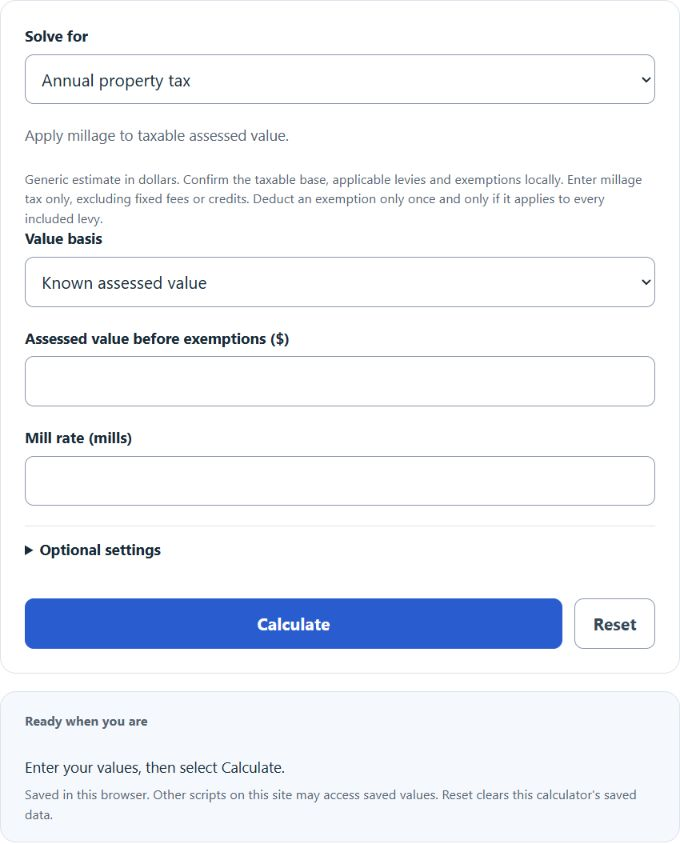
Estimate annual millage tax, mill rate, or assessed value using a stated assessment ratio and deduction, with monthly budgeting amounts. Fixed fees and tax credits are outside this model.
Mill Rate Formula
- Mill Rate: tax in dollars per $1,000 of taxable assessed value (1 mill = $1 per $1,000).
- Assessed Value: market value × assessment ratio.
- Exemptions: homestead, senior, veteran, or other deductions subtracted before tax is applied.
- Millage Tax: tax attributable to the stated millage, excluding fixed fees and credits. For a jurisdiction-wide levy calculation, use the matching aggregate taxable base.
Assessment ratios vary by jurisdiction. Some areas assess at 100% of market value, others use a fraction (for example 70% or 10%). Always confirm whether a posted rate is in mills, percent, or dollars per $1,000 before plugging it in.
Reference Tables
Use these to sanity-check the calculator output and convert between common rate formats.
| Mill Rate | Effective % | $ per $1,000 | Tax on $250,000 |
|---|---|---|---|
| 5 mills | 0.50% | $5.00 | $1,250 |
| 10 mills | 1.00% | $10.00 | $2,500 |
| 15 mills | 1.50% | $15.00 | $3,750 |
| 20 mills | 2.00% | $20.00 | $5,000 |
| 25 mills | 2.50% | $25.00 | $6,250 |
| 30 mills | 3.00% | $30.00 | $7,500 |
| If you have… | To get mills, do this |
|---|---|
| A percent rate (e.g. 1.25%) | Multiply by 10 (= 12.5 mills) |
| Dollars per $1,000 | It already equals mills |
| Dollars per $100 | Multiply by 10 |
| A decimal rate (e.g. 0.0125) | Multiply by 1,000 |
Example and FAQ
Example. A home is valued at $300,000 in a district that assesses at 100% with a $25,000 homestead exemption and a 22-mill rate. Taxable value is $275,000. Annual tax = 275,000 × 22 ÷ 1,000 = $6,050.
What is a mill? One mill is one-thousandth of a dollar, or $1 of tax for every $1,000 of assessed value.
Why is my mill rate different from my effective tax rate? The mill rate applies to assessed value. If your jurisdiction assesses below market value, the effective rate against market value will be lower than mills ÷ 10 suggests.
Do exemptions change the mill rate? No. Exemptions reduce the taxable value before the rate is applied. The mill rate stays the same.
How do I find the mill rate from my tax bill? Divide tax attributable to millage by taxable assessed value after the applicable deduction, then multiply by 1,000. Choose Mill rate above.