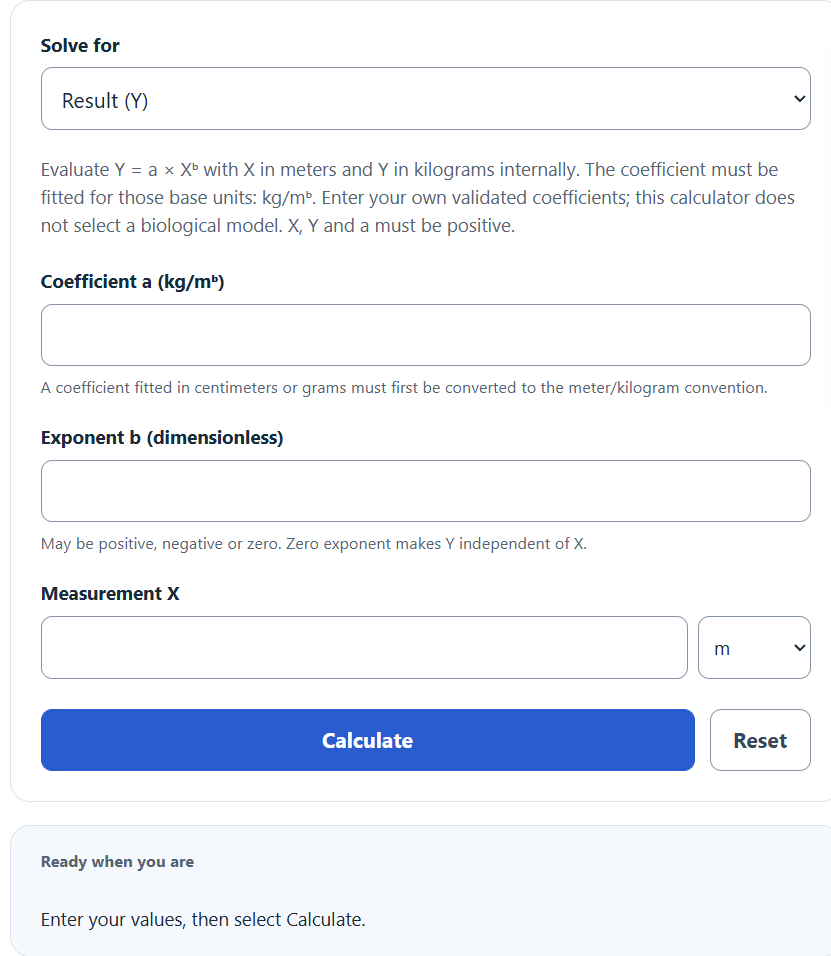
Calculate the missing allometric equation value in Y = aX^b from coefficient, exponent, measurement, and result with length and mass units.
Related Calculators
- Bone Length To Body Height Calculator
- Femur To Foot Ratio Calculator
- Height to Finger Length Calculator
- Protein Hydrodynamic Radius Calculator
- All Biology Calculators
Allometric Equation Formula
The allometric equation relates a measurement, such as length or height, to a result, such as mass or weight. The calculator uses the standard power-law form:
- Y = result, converted through kilograms as the base unit
- a = coefficient, or scaling constant
- X = measurement, converted through meters as the base unit
- b = exponent, or scaling exponent
If you select Coefficient in Solve for, the calculator rearranges the formula as:
If you select Exponent in Solve for, the calculator uses logarithms:
If you select Measurement in Solve for, the calculator solves for X:
If you select Result in Solve for, the calculator solves the main allometric equation directly:
Select the unknown and enter the other three values. X, Y and a must be positive. The calculator converts known measurements to meters and masses to kilograms. Solved lengths and masses are displayed in base units with useful unit equivalents. The coefficient must use kg/m^b.
Unit Conversions Used in the Allometric Equation
The calculation is done in base units, with X in meters and Y in kilograms.
| Measurement unit | Base conversion to meters |
|---|---|
| Meters, m | 1 m |
| Centimeters, cm | 0.01 m |
| Millimeters, mm | 0.001 m |
| Inches, in | 0.0254 m |
| Feet, ft | 0.3048 m |
| Result unit | Base conversion to kilograms |
|---|---|
| Kilograms, kg | 1 kg |
| Grams, g | 0.001 kg |
| Pounds, lb | 0.45359237 kg |
| Tonnes, t | 1000 kg |
Example Allometric Equation Calculations
Example 1: Calculate the result
Suppose the coefficient is 2.5, the exponent is 3, and the measurement is 4 meters.
The primary result is 160 kg, with equivalent masses below it.
Example 2: Calculate the coefficient
Suppose the result is 80 kg, the measurement is 2 meters, and the exponent is 3.
The coefficient is 10.
FAQ
What does the exponent mean in an allometric equation?
The exponent controls how quickly the result changes as the measurement changes. If b = 1, the relationship is linear. If b > 1, the result increases faster than the measurement. If 0 < b < 1, the result increases more slowly than the measurement.
Why do units matter in an allometric equation?
Units matter because the coefficient depends on the units used for X and Y. A coefficient fitted using meters and kilograms will not usually give the same numerical result if you enter centimeters and grams without conversion. This calculator converts values through meters and kilograms to keep the calculation consistent.
Why can the exponent calculation fail?
Solving for the exponent requires positive X, Y and a, and X must not equal 1 meter. At X = 1 meter, Y = a for every exponent, so the exponent is either nonunique or the inputs conflict. Solving X also requires a nonzero exponent.