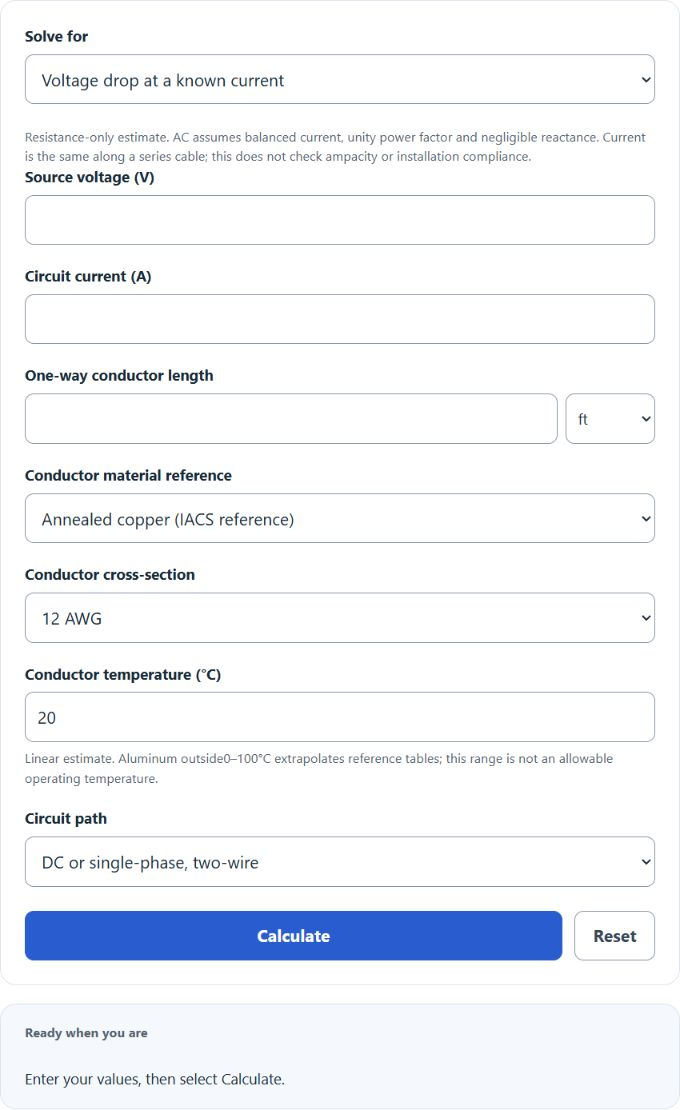
Calculate cable voltage drop, delivered current for a resistive load, conductor heat, or maximum run length using copper/aluminum and AWG/mm² options.
Related Calculators
- Motor Current Calculator
- 3 Phase Generator Sizing Calculator
- Diode Selection Calculator
- Norton’s Theorem Calculator
- All Physics Calculators
Amp Loss Over Distance Formula
The calculator does not reduce amps along the wire. Along an unbranched series path the current is the same at every point. What changes over distance is voltage. The wire has resistance, so some of the source voltage is dropped across the conductors before it reaches the load. That is what people usually mean by “amp loss over distance.”
The base voltage drop formula is:
- Vdrop = voltage dropped across the wire, in volts
- K = circuit factor: 2 for DC or single-phase 2-wire, 1.732 for three-phase
- I = load current in amps
- R = temperature-adjusted conductor resistance in ohms per 1000 feet, derived from resistivity and cross-sectional area
- L = one-way wire length in feet
The model uses R(T) = R(20) × [1 + α20 × (T − 20)]. The reference values are 1.724 × 10^-8 Ω·m and α20 = 0.00393/°C for annealed copper, and 2.826 × 10^-8 Ω·m and α20 = 0.00403/°C for EC-H19 aluminum (61% IACS). It neglects thermal expansion and AC reactance; AC estimates assume unity power factor and balanced three-phase current. Other alloys and cable construction can differ.
Maximum one-way distance for a chosen drop limit:
Current with a fixed resistive load in a two-wire circuit is:
The Solve for selector offers voltage drop at known current, current with a resistive load, and maximum one-way distance for a chosen drop percentage. Roneway is the resistance of one conductor over the entered length. Load mode compares the circuit current with Vsource / Rload; it does not mean current disappears along the wire. Select a listed AWG or enter area in mm². This tool does not select a compliant wire size or check ampacity.
Reference Tables
These approximate resistance values at 20°C provide a reference check. Aluminum values represent EC-H19. The 4/0 row is reference only; use custom area for a size absent from the selector. Nominal area does not establish an allowable current.
| AWG | Copper Ω/1000 ft | Aluminum Ω/1000 ft | Nominal area (mm²) |
|---|---|---|---|
| 14 | 2.525 | 4.14 | 2.081 |
| 12 | 1.588 | 2.60 | 3.309 |
| 10 | 0.999 | 1.64 | 5.261 |
| 8 | 0.628 | 1.03 | 8.367 |
| 6 | 0.395 | 0.65 | 13.30 |
| 4 | 0.249 | 0.41 | 21.15 |
| 2 | 0.156 | 0.26 | 33.62 |
| 1/0 | 0.098 | 0.16 | 53.49 |
| 4/0 | 0.049 | 0.080 | 107.2 |
Voltage drop targets depend on equipment and installation requirements. The following percentages are illustrative planning inputs, not compliance limits or installation recommendations. Confirm the applicable requirements separately.
| Illustrative planning example | Example drop target |
|---|---|
| Branch circuit example | 3% |
| Feeder + branch combined | 5% |
| 12 V DC (RV, solar, marine) | 3% or 10%, depending on the chosen scenario |
| Motor branch circuits | 3% |
| Low-voltage lighting | 5-10% |
Worked Examples and FAQ
Example 1. A 20 A load on 12 AWG copper at 120 V, single-phase, 100 ft one-way:
At 20°C, Vdrop ≈ 2 × 20 × 1.588 × 100 / 1000 = 6.35 V, or about 5.3%. For a 3% planning target, 10 AWG still gives about 4.00 V (3.33%); 8 AWG gives about 2.51 V (2.09%). Shortening the run also lowers drop. These calculations alone do not establish an acceptable installation.
Example 2. 30 A at 240 V single-phase, 3% drop limit, 10 AWG copper. Max drop = 7.2 V.
Lmax = (7.2 × 1000) / (2 × 30 × 0.999) = approximately 120 ft one-way at 20°C.
Does current actually drop along the wire? No. Series circuit current is constant. The conductors dissipate power as heat. With a fixed resistance load, their added series resistance also lowers the entire circuit current compared with a zero-length wire; use the load mode to estimate that change.
Why use one-way length and not total wire length? The circuit factor of 2 already accounts for the return conductor in DC and single-phase circuits. Entering total loop length would double-count it.
Why is aluminum resistance higher? The EC-H19 aluminum reference has 61% IACS conductivity, giving roughly 1.64 times the annealed copper resistance at 20°C and equal area. The calculator uses separate material resistivity and temperature coefficients. Alloy and temper affect the actual value.
Does this account for temperature? Yes. Enter conductor temperature; the linear model references 20°C / 68°F. At 75°C, copper resistance and fixed-current drop are about 21.6% higher than at 20°C (EC-H19 aluminum about 22.2%). Aluminum outside 0–100°C extrapolates the reference tables. The input range is a mathematical range, not an allowable operating temperature.