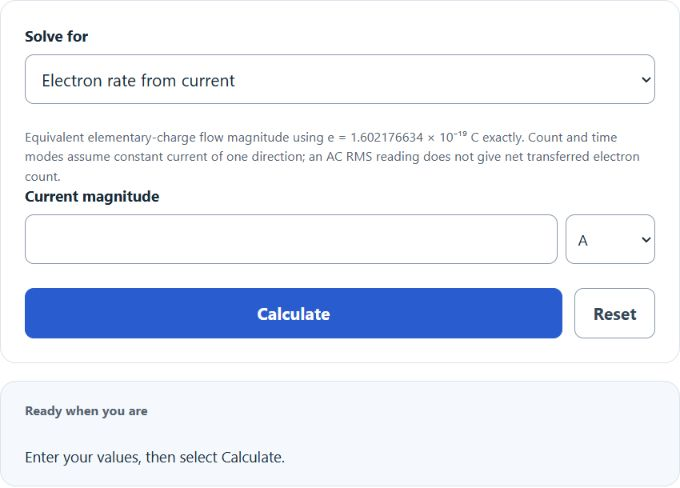
Convert amps to electrons per second with the exact SI elementary charge, total electrons over time, or reverse electron count and duration to current.
- Amps to kVA Calculator
- Electricity, Magnetism, and Electronics Unit Converters
- Electrons Per Second to Amps Calculator
- Amps to Coulombs Calculator
- Coulombs Per Second Calculator
- Ampere to Coulomb Per Second Conversion Calculator
- All Unit Converters
Amps To Electrons Per Second Formula
Variables:
- EPS is the Amps To Electrons Per Second (electrons per second)
- A is the total current (amps)
Divide current magnitude in amperes by the exact elementary charge magnitude, 1.602176634 × 10⁻¹⁹ C. The reciprocal is approximately 6.241509074 × 10¹⁸ elementary charges per coulomb; displayed values are rounded.
| Current (A) | Electrons per second (e/s) |
|---|---|
| 0.000001 | 6.241509074e+12 |
| 0.00001 | 6.241509074e+13 |
| 0.0001 | 6.241509074e+14 |
| 0.0005 | 3.120754537e+15 |
| 0.001 | 6.241509074e+15 |
| 0.002 | 1.248301815e+16 |
| 0.005 | 3.120754537e+16 |
| 0.01 | 6.241509074e+16 |
| 0.02 | 1.248301815e+17 |
| 0.05 | 3.120754537e+17 |
| 0.1 | 6.241509074e+17 |
| 0.5 | 3.120754537e+18 |
| 1 | 6.241509074e+18 |
| 2 | 1.248301815e+19 |
| 5 | 3.120754537e+19 |
| 10 | 6.241509074e+19 |
| 20 | 1.248301815e+20 |
| 50 | 3.120754537e+20 |
| 100 | 6.241509074e+20 |
| 1000 | 6.241509074e+21 |
| Uses e = 1.602176634 × 10⁻¹⁹ C exactly; rates are rounded to ten significant digits. This is equivalent elementary-charge flow, not a net AC count. | |
How to Calculate Amps To Electrons Per Second?
The following steps outline how to calculate the Amps To Electrons Per Second.
- First, determine the total current (amps).
- Next, use rate = current magnitude / e, with e = 1.602176634 × 10⁻¹⁹ C exactly.
- Finally, calculate the Amps To Electrons Per Second.
- After inserting the variables and calculating the result, check your answer with the calculator above.
Example Problem :
Use the following variables as an example problem to test your knowledge.
total current (amps) = 5. The equivalent rate is approximately 3.120754537 × 10¹⁹ electrons/s. At constant one-direction current, count over time is I × t / e; time to a target is N × e / I.
FAQ
What is an ampere and how is it related to electrons?
An ampere is the SI unit of current, equal to one coulomb per second. The SI fixes elementary charge magnitude e at exactly 1.602176634 × 10⁻¹⁹ C. One ampere therefore corresponds to approximately 6.241509074 × 10¹⁸ elementary charges per second. Electrons have charge −e, so their drift in a metal is opposite conventional current.
Why is the number 6.242E18 significant in converting amps to electrons per second?
6.242 × 10¹⁸ is a coarse rounding of 1/e in elementary charges per coulomb. The calculator divides by the exact SI value of e rather than using that rounded multiplier. It reports an equivalent count magnitude; charge carriers in other materials may be ions or holes.
Can the formula be used for any type of electrical current?
Instantaneous current can be expressed as signed charge flow, but an AC RMS reading divided by e is not a net one-way transfer rate. Count and duration modes here assume constant current of one direction. For varying current, net charge is the time integral of signed current; a complete AC cycle can give zero net transfer. This calculation does not count random microscopic electron motion.
How can this calculation help in practical applications?
The conversion helps relate macroscopic current to elementary charge, transferred charge and an idealized carrier-count rate. It does not by itself establish circuit safety, operating efficiency or the physical transport mechanism.