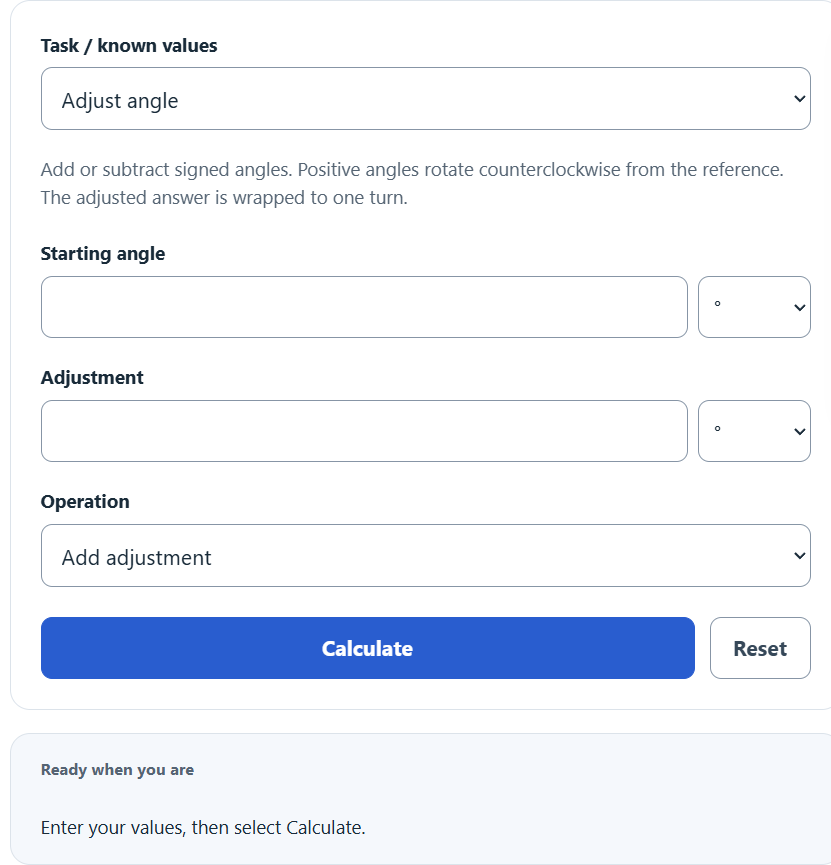
Calculate adjusted angles, angle differences, unit conversions, and right triangle sides, area, and acute angles from known values.
Angle Adjustment Formulas
Choose a task or known right-triangle values from the task selector. Each choice shows only its required inputs.
Adjust angle. Add or subtract one angle from another, then wrap the result into the range 0° ≤ result < 360°.
Angle between two directions. Take the difference and normalize it both ways around the circle. The formulas below use counterclockwise-increasing readings. For clockwise compass bearings, exchange the clockwise and counterclockwise labels.
Unit conversion. All units route through degrees.
Right triangle. Solve the triangle, then read the acute angles.
- start: the angle you begin with
- change: the amount you add or subtract
- A, B: two angles or line directions measured from the same reference
- rad, grad, turn: angle in radians, gradians, or full turns
- a, b: legs of a right triangle
- c: hypotenuse
- alpha, beta: the two acute angles, opposite legs a and b
Assumptions: adjustment angles are signed and positive angles rotate counterclockwise. For angle-between calculations, select whether readings increase clockwise or counterclockwise. Adjusted angles are wrapped to 0° ≤ result < 360°; conversion retains the full angle. Angle inputs and unwrapped adjustment totals are limited to a magnitude of 1 billion degrees. Right-triangle inputs must be positive, any known leg must be shorter than the hypotenuse, and the leg ratio must not exceed 1 trillion.
Each task maps to one job. Use Adjust angle for an adjusted direction, Angle between for the gap between directions, or Convert angle for degree, radian, gradian and turn equivalents. The five Triangle choices preserve the two-leg, hypotenuse-and-leg, and area-and-leg methods. Choose physical units beside each input, or use unspecified units consistently for both known measurements.
Reference Tables
Common angles in every unit the calculator supports:
| Degrees | Radians | Gradians | Turns |
|---|---|---|---|
| 0° | 0 | 0 | 0 |
| 30° | π/6 ≈ 0.5236 | 33.33 | 1/12 |
| 45° | π/4 ≈ 0.7854 | 50 | 1/8 |
| 60° | π/3 ≈ 1.0472 | 66.67 | 1/6 |
| 90° | π/2 ≈ 1.5708 | 100 | 1/4 |
| 180° | π ≈ 3.1416 | 200 | 1/2 |
| 270° | 3π/2 ≈ 4.7124 | 300 | 3/4 |
| 360° | 2π ≈ 6.2832 | 400 | 1 |
Quadrant guide for the wrapped result (axis boundaries are excluded; sine or cosine is zero on an axis):
| Range | Quadrant | Sin / Cos signs |
|---|---|---|
| 0° to 90° | I | + / + |
| 90° to 180° | II | + / − |
| 180° to 270° | III | − / − |
| 270° to 360° | IV | − / + |
Worked Examples
Example 1: Wrap past 360°. Start at 350° and add 25°. The raw sum is 375°. Subtract 360° to wrap: the final angle is 15°.
Example 2: Subtract through zero. Start at 20° and subtract 50°. The raw sum is −30°. Add 360°: the final angle is 330°.
Example 3: Angle between bearings. Select Clockwise (bearings). Line A points at 15°, line B at 110°. Going clockwise from A to B is 95°. Going counterclockwise is 265°. The shortest separation is 95°.
Example 4: Right triangle from two legs. With a = 3 and b = 4, the hypotenuse is 5. The angle opposite a is arcsin(3/5) ≈ 36.87°, and the other acute angle is 53.13°.
FAQ
Why is my result different from the unwrapped sum? The main result is normalized to one full turn. The unwrapped value shows the raw sum before wrapping, which can exceed 360° or be negative.
Does the calculator handle negative angles? Yes. Enter signed angles within the supported numerical range. In the adjustment task, negative angles rotate clockwise from the reference direction.
What is a gradian? A gradian splits a right angle into 100 parts, so a full turn is 400 gradians. It is used in some surveying and engineering contexts.
Which acute angle is alpha in the right triangle mode? Alpha is opposite leg a, and beta is opposite leg b. They always add to 90°.
Can I use the angle-between mode for compass bearings? Yes. Select Clockwise (bearings) and measure both bearings from the same reference. Select Counterclockwise instead for standard mathematical angle readings.