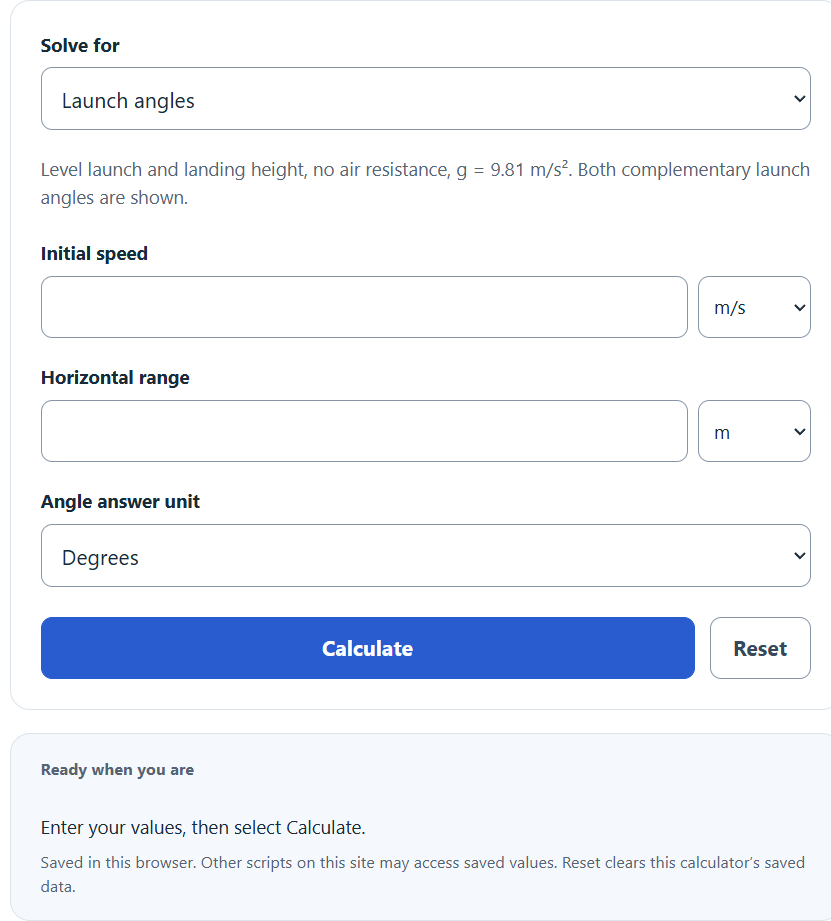
Calculate the angle of projection, range, or initial velocity from any two values using m/s, km/h, mph, ft/s, meters, km, miles, yards, feet, degrees, or radians.
Related Calculators
- Initial Horizontal Velocity Calculator
- Constant Velocity Calculator
- Magnitude of Force Calculator
- Resistance Force Calculator
- All Physics Calculators
Angle Of Projection Formula
The angle of projection calculator uses the standard projectile range equation for a projectile launched and landing at the same height, with air resistance ignored.
- R = horizontal range of the projectile
- v = initial velocity
- theta = angle of projection
- g = acceleration due to gravity, usually 9.81 m/s2
Select Launch angles, Horizontal range or Initial speed, then enter the two visible values. If you enter initial velocity and angle, the calculator finds the range. If you enter range and angle, it rearranges the same equation to find the required initial velocity. If you enter initial velocity and range, it solves for the angle of projection.
For a given velocity and range, there can be two possible launch angles: a lower angle and a higher complementary angle. The calculator shows both the lower principal angle and the higher complementary angle. They coincide at 45° for the maximum range.
Common Projectile Angle Results
For level-ground projectile motion, the range depends on sin(2θ). The largest range occurs at 45 degrees when air resistance is ignored.
| Angle | sin(2θ) | Range compared with maximum |
|---|---|---|
| 15° | 0.500 | 50% |
| 30° | 0.866 | 86.6% |
| 45° | 1.000 | 100% |
| 60° | 0.866 | 86.6% |
| 75° | 0.500 | 50% |
Unit Conversions Used
| Quantity | Unit | Base-unit conversion |
|---|---|---|
| Velocity | km/h | 1 km/h ≈ 0.277778 m/s |
| Velocity | mph | 1 mph = 0.44704 m/s |
| Distance | feet | 1 ft = 0.3048 m |
| Distance | yards | 1 yd = 0.9144 m |
| Angle | degrees | degrees × π / 180 = radians |
Example Problems
Example 1: Find the range
You launch a projectile at an initial velocity of 20 m/s and an angle of 30°.
The range is about 35.31 m.
Example 2: Find the angle of projection
You know the projectile has an initial velocity of 25 m/s and a range of 40 m.
The lower angle of projection is about 19.4455°. The complementary angle, about 70.5545°, gives the same range under ideal conditions.
FAQ
Why does 45 degrees give the maximum range?
The range formula contains sin(2θ). The largest possible value of sine is 1, and that happens when 2θ = 90°. Therefore, θ = 45° gives the maximum range when launch height and landing height are the same and air resistance is ignored.
Why can two different angles give the same range?
Angles that add to 90 degrees have the same range in ideal projectile motion. For example, 30° and 60° give the same value of sin(2θ), so they produce the same horizontal range if the initial velocity is the same.
When is there no valid angle?
There is no valid angle if the requested range is too large for the given initial velocity. In the formula, (R × g) / v² must be between 0 and 1 for this nonnegative-range model. Angles are restricted to 0°–90°. Zero speed cannot determine a unique angle; zero range at an endpoint angle cannot determine a unique speed.