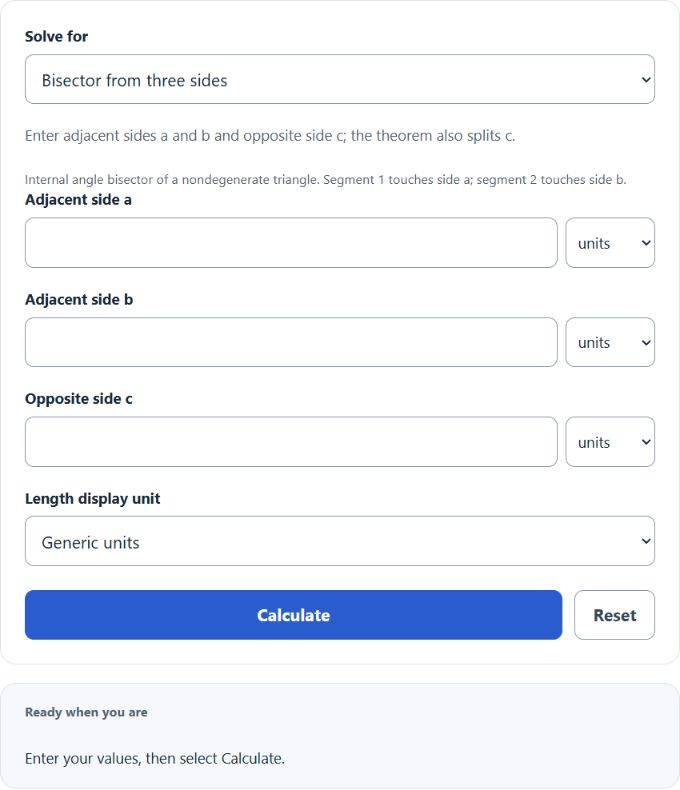
Calculate angle bisector length from two sides and the included angle, or use side ratios to split the opposite side and find a missing segment.
Related Calculators
- Angle Ratio Calculator
- Distance To Angle Calculator
- Perpendicular Line Calculator
- Central Angle Calculator
- Area Of Sector Calculator
- Heron’s Formula Calculator
- All Math and Numbers Calculators
Angle Bisector Formula
The angle bisector length is calculated from the two sides that form the angle and the side opposite that angle. Three-side mode returns the bisector, vertex angle, side segments and area. Two-side-and-angle mode uses l = 2ab cos(A/2)/(a+b), with an included angle strictly between 0° and 180°. Missing-segment mode uses segment 2 = segment 1 × b/a, where segment 1 touches side a; the resulting three sides must form a valid triangle.
- l = internal angle bisector length
- a = adjacent side 1
- b = adjacent side 2
- c = opposite side
The calculator also finds the full vertex angle using the Law of Cosines:
The half angle is:
The angle bisector divides the opposite side in the same ratio as the two adjacent sides:
The triangle area is calculated with Heron’s formula:
- A = vertex angle between sides a and b
- s = semiperimeter of the triangle
- Area = triangle area in square units
To use the formulas correctly, all three side lengths must be positive and must form a valid triangle. That means each pair of sides must add up to more than the remaining side.
Angle Bisector Result Reference
Use these tables to interpret the values returned by the calculator.
| Result | What it means | Unit |
|---|---|---|
| Angle Bisector Length | Distance from the vertex to the opposite side along the angle bisector | Same unit as the side lengths |
| Vertex Angle | The full angle between the two adjacent sides | Degrees |
| Half Angle | One of the two equal angles created by the bisector | Degrees |
| Opposite Side Segments | The two parts of the opposite side after the bisector meets it | Same unit as the side lengths |
| Triangle Area | Area enclosed by the three sides | Square units |
Valid Triangle Checks
| Check | Required condition | Example failure |
|---|---|---|
| Adjacent sides compared with opposite side | a + b > c | 4 + 5 is not greater than 10 |
| Side a compared with the other sides | b + c > a | 3 + 4 is not greater than 9 |
| Side b compared with the other sides | a + c > b | 2 + 6 is not greater than 10 |
Angle Bisector Examples
Example 1
Find the internal angle bisector when the adjacent sides are 8 and 10, and the opposite side is 12.
- a = 8
- b = 10
- c = 12
The angle bisector length is 6.666667 units.
Example 2
Find the opposite side segments for a triangle with adjacent sides 6 and 9, and opposite side 10.
- a = 6
- b = 9
- c = 10
The angle bisector divides the opposite side into segments of 4 units and 6 units.
Angle Bisector Calculator FAQ
What sides do I enter in the calculator?
Enter the two sides that touch the angle you want to bisect as the adjacent sides. Enter the side across from that angle as the opposite side. The angle bisector starts at the vertex between the two adjacent sides and ends on the opposite side.
Why does the calculator reject some side lengths?
The three side lengths must form a real triangle. If one side is too long compared with the other two, the triangle cannot exist. For example, sides 4, 5, and 10 are invalid because 4 + 5 is not greater than 10.
Does the unit selection change the calculation?
Physical unit selectors convert quantities, so changing meters to centimeters preserves the side length. You may mix physical input units and choose a physical result unit. Generic units mean a common unspecified unit for all sides; do not mix generic and physical lengths. Area uses the square of the selected result unit.