Calculate angular frequency from frequency, period, RPM, or ω and convert between rad/s, Hz, period, and RPM in one quick, easy step.
Related Calculators
- BLDC Speed Calculator
- 1 Phase To 3 Phase Calculator
- KVAR Calculator
- Capacitor Voltage Calculator
- All Physics Calculators
Angular Frequency Formula
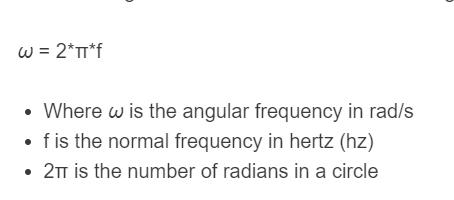
The calculator converts whatever you enter into angular frequency (ω) in radians per second using one of these forms:
- ω — angular frequency (rad/s)
- f — frequency (Hz, cycles per second)
- T — period (seconds per cycle)
- RPM — revolutions per minute
One full cycle equals 2π radians, so every form above is the same idea expressed in different units. If you enter ω directly, the calculator inverts these to give you f and T. Inputs are converted to SI before computation (kHz to Hz, ms to s, deg/s to rad/s, etc.).
Reference Values
Quick comparisons to sanity-check your result:
| Source | f (Hz) | ω (rad/s) |
|---|---|---|
| Pendulum (1 m) | 0.5 | 3.13 |
| EU mains | 50 | 314.16 |
| US mains | 60 | 376.99 |
| Concert A4 | 440 | 2,764.6 |
| AM radio (mid) | 1.0 × 10⁶ | 6.28 × 10⁶ |
| Wi-Fi (2.4 GHz) | 2.4 × 10⁹ | 1.508 × 10¹⁰ |
| Rotation | RPM | ω (rad/s) |
|---|---|---|
| Clock minute hand | 0.0167 | 0.00175 |
| Vinyl record (33⅓) | 33.3 | 3.49 |
| Ceiling fan | 300 | 31.4 |
| Car engine (idle) | 800 | 83.8 |
| Drill motor | 3,000 | 314.2 |
Worked Example & FAQ
Example: A signal has a period of 20 ms. Find ω.
T = 0.020 s. ω = 2π / 0.020 = 314.16 rad/s. The frequency is f = 1/T = 50 Hz.
Why use radians instead of Hz? Most physics and electrical engineering equations (simple harmonic motion, AC impedance, phasors) are written in terms of ω because the math is cleaner without 2π factors scattered through it.
Is angular frequency the same as angular velocity? The units (rad/s) match. For steady rotation, angular frequency equals the magnitude of angular velocity. Signed rotation indicates direction; frequency and period use nonnegative magnitudes. A zero frequency has no finite period.
How do I go from RPM to rad/s? Divide RPM by 60 to get rev/s, then multiply by 2π. So 1800 RPM = 30 rev/s = 188.5 rad/s.