Calculate reactive power in kVAR from kW and power factor, kVA, or voltage and current, and size capacitor banks for power factor correction.
- All Physics Calculators
- Fault Current Calculator
- Circuit Breaker Size Calculator
- X/R Ratio Calculator
- Kva To Kw
KVAR Formula
The following formulas are used to calculate reactive power. When reactance X is in ohms (Ω) and current I is in amps (A), the result of X·I² is in VAR (volt‑ampere reactive). Divide by 1000 to convert to kVAR.
- Where Q is the reactive power in VAR
- kVAR is reactive power expressed in kilovolt‑ampere reactive (1 kVAR = 1000 VAR)
- X is the (net) reactance of the system (ohms)
- I is the RMS current of the system/circuit (amps)
To calculate the reactive power in kVAR, multiply the reactance by the current squared, then divide by 1000.
KVAR Definition
What is KVAR?
kVAR (kilovolt‑ampere reactive) is a unit used to express electrical reactive power in AC power systems. Reactive power is associated with energy that oscillates between the source and reactive components (inductors and capacitors), and it is commonly discussed in power factor correction and capacitor bank sizing. (1 kVAR = 1000 VAR.)
Example Problem
How to calculate KVAR?
- First, determine the reactance of the savings system.
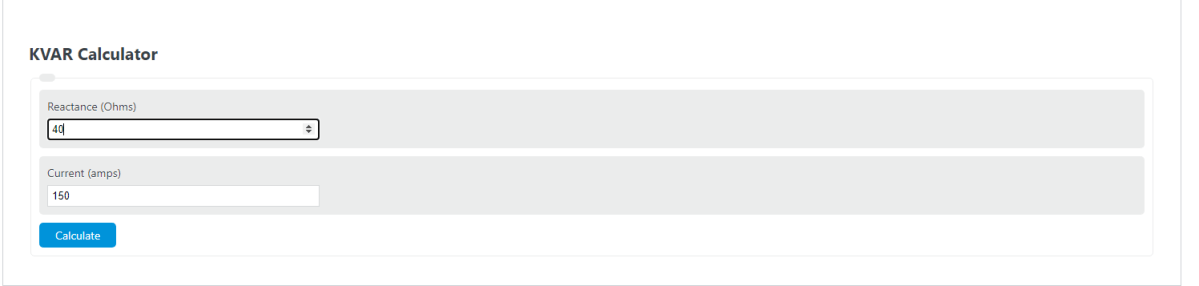
For this problem, the reactance is calculated to be 40 ohms.
- Next, determine the current of the system.
For this example, the current of the circuit is measured to be 150 amps.
- Finally, calculate the KVAR.
Using the formula above, the kVAR is calculated to be:
kVAR = (X · I^2) / 1000
kVAR = (40 · 150^2) / 1000
kVAR = 900 kVAR