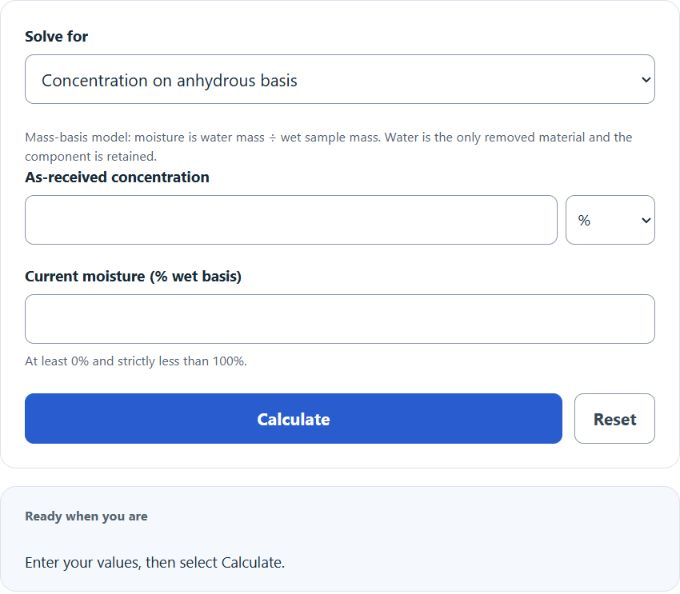
Convert a component concentration between wet and anhydrous bases or calculate dry sample mass from moisture content, with percent, ppm, mass, and water-loss results.
Anhydrous Basis Formula
The calculator uses one core moisture conversion plus a stoichiometric formula for hydrate masses. Each solve mode applies a different rearrangement; dry sample mass additionally uses wet mass × (1 − W/100).
As-is to anhydrous basis:
Anhydrous to as-is basis:
Change moisture (current to target):
Hydrate mass conversion:
- A_anh = assay reported on an anhydrous (dry) basis
- A_asis = assay on the as-is (wet) sample
- A_current, A_target = assay at current and target moisture levels
- W = water (moisture) content, in percent
- M_anh = molar mass of the anhydrous compound, g/mol
- M_hydrate = molar mass of the hydrated compound, g/mol
- n = number of waters of hydration per formula unit
- f = anhydrous factor, grams of anhydrous per gram of hydrate
- 18.01528 = assumed approximate molar mass of water, g/mol
Assumptions: moisture is reported in weight percent, water is the only volatile component removed on drying, and the analyte itself is non-volatile. Moisture must be less than 100%. For hydrate calculations the compound is assumed to be a pure stoichiometric hydrate with no surface or excess water.
How the solve modes map to the formulas:
- As-is → anhydrous divides out the water fraction so the analyte is expressed per unit of dry mass.
- Anhydrous → as-is dilutes the dry-basis value back into the wet sample by multiplying by the dry fraction.
- Change moisture chains the two operations: it lifts the assay to the anhydrous basis, then drops it back down at the target moisture.
- Hydrate mass uses molar masses to compute the anhydrous fraction f, then scales the input mass up or down depending on direction.
Reference Tables
Use these to sanity-check your inputs and outputs. The first table shows how moisture changes the multiplier between as-is and anhydrous values. The second gives illustrative hydrate calculations using the stated approximate anhydrous molar masses and 18.01528 g/mol for water. Use the molar mass and hydrate form appropriate to your material.
| Water content (%) | As-is → anhydrous multiplier | Anhydrous → as-is multiplier |
|---|---|---|
| 0.5 | 1.0050 | 0.9950 |
| 2 | 1.0204 | 0.9800 |
| 5 | 1.0526 | 0.9500 |
| 10 | 1.1111 | 0.9000 |
| 15 | 1.1765 | 0.8500 |
| 25 | 1.3333 | 0.7500 |
| 50 | 2.0000 | 0.5000 |
| Hydrate | n (H₂O) | Anhydrous factor f | Water in hydrate (%) |
|---|---|---|---|
| MgSO₄·7H₂O (anhydrous molar mass 120.366 g/mol) | 7 | 0.4884 | 51.16 |
| CuSO₄·5H₂O (anhydrous molar mass 159.609 g/mol) | 5 | 0.6392 | 36.08 |
| Na₂CO₃·10H₂O (anhydrous molar mass 105.9888 g/mol) | 10 | 0.3704 | 62.96 |
| Na₂SO₄·10H₂O (anhydrous molar mass 142.042 g/mol) | 10 | 0.4409 | 55.91 |
| CaCl₂·2H₂O (anhydrous molar mass 110.98 g/mol) | 2 | 0.7549 | 24.51 |
| C₆H₈O₇·H₂O (anhydrous molar mass 192.1235 g/mol) | 1 | 0.9143 | 8.57 |
| CH₃COONa·3H₂O (anhydrous molar mass 82.0343 g/mol) | 3 | 0.6028 | 39.72 |
Worked Examples and FAQ
Example 1: As-is to anhydrous. A protein sample assays at 82.4% on the as-is basis and contains 6.5% moisture. Anhydrous assay = 82.4 × 100 / (100 − 6.5) = 82.4 / 0.935 = 88.13%.
Example 2: Anhydrous to as-is. A pharmaceutical specification calls for 99.5% on a dried basis. Assume the lot has 2.1% water by wet mass; this example treats any drying loss as water only. As-is value = 99.5 × (100 − 2.1) / 100 = 99.5 × 0.979 = 97.41%.
Example 3: Change moisture. A grain sample assays 11.0% protein at 14% moisture. To report at 12% moisture: A_target = 11.0 × (100 − 12) / (100 − 14) = 11.0 × 88 / 86 = 11.26%.
Example 4: Hydrate mass. You need 25 g of anhydrous MgSO₄ but only have the heptahydrate. Using anhydrous molar mass 120.366 g/mol and n = 7, f = 0.4883537732. Mass of hydrate = 25 / f = 51.19 g.
Why convert to an anhydrous basis at all? Moisture changes from lot to lot and even hour to hour with humidity. Reporting on a dry basis removes that variability so two samples can be compared directly.
Is anhydrous basis the same as dry basis? In most analytical contexts yes. Both refer to the assay calculated as if all water were removed. The term “as-received” or “as-is” refers to the wet sample.
What if my moisture method removes more than just water? The formula assumes loss on drying equals water. If volatile organics also evaporate, the calculated anhydrous value will be biased high. Use a water-specific method like Karl Fischer titration when this matters.
Can I use ppm or mg/g instead of percent? Yes. The assay unit selector handles ppm, mg/g, fraction, and percent. Moisture must still be entered as a percent because it is always a mass fraction of the whole sample.
What does the anhydrous factor f mean? It is the grams of anhydrous compound contained in one gram of the hydrate. For CuSO₄·5H₂O using 159.609 g/mol for anhydrous CuSO₄, f ≈ 0.6392, so 1 g of pure hydrate corresponds to about 0.6392 g of anhydrous CuSO₄.