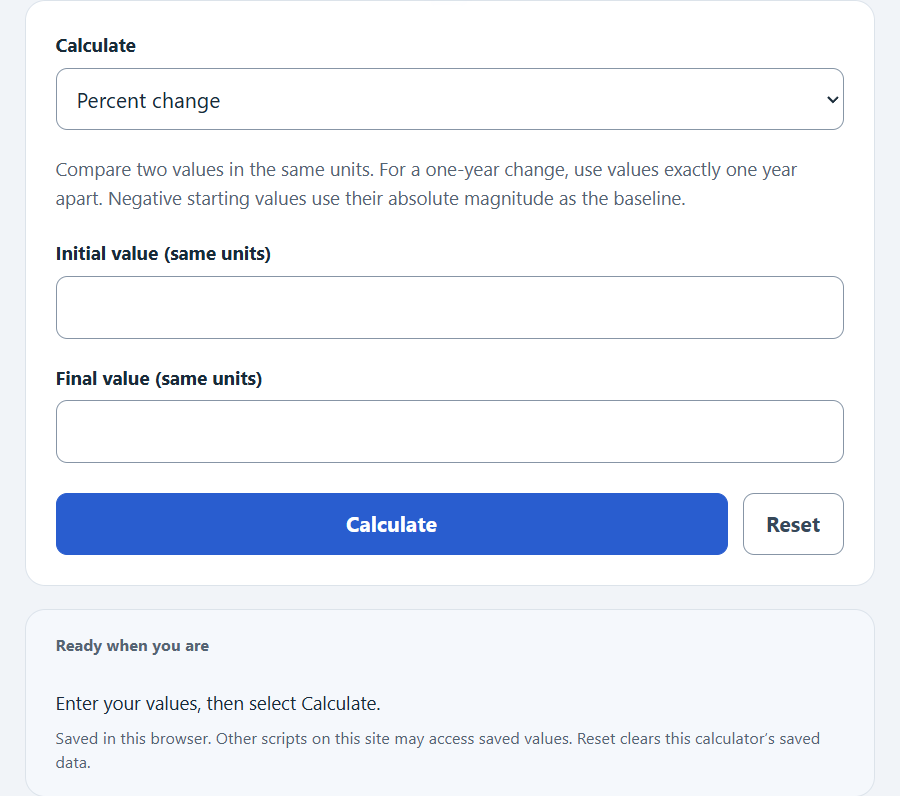
Calculate percent change, annualized change, and inflation-adjusted equivalent amounts from initial and final values or CPI.
Related Calculators
- Decay Percentage Calculator
- Percentage Difference Calculator
- Time Percentage Calculator
- Average Slope Calculator
- All Math and Numbers Calculators
Annual Change Formula
The following formula gives signed percent change. It is an annual change only when the values are one year apart. Negative initial values use an absolute-baseline convention.
Variables:
- AC is the signed percent change over the selected interval
- FV is the final value
- IV is the initial value
Subtract the initial value from the final value, divide by the absolute initial value, and multiply by 100. An initial value of zero has no defined percent change. For positive endpoints, CAGR = ((FV / IV)^(1 / years) – 1) × 100; this differs from dividing total percent change by years.
What is Annual Change?
Annual change refers to the percentage change in a value over the course of a year. This metric is commonly used in finance, economics, and various other fields to measure the growth or decline of a particular variable, such as revenue, population, or investment returns. Understanding the annual change helps in analyzing trends and making informed decisions based on the rate of change over time.
How to Calculate Annual Change?
The following steps outline how to calculate the annual change.
- First, determine the initial value (IV).
- Next, determine the final value (FV).
- Select Percent change for a one-year comparison, or Annualized change and enter elapsed time for a longer interval.
- Select Calculate. Inflation modes instead use your supplied annual rate or comparable CPI indexes.
- After inserting the values and calculating the result, check your answer with the calculator above.
Example Problem :
Use the following variables as an example problem to test your knowledge.
Initial Value (IV) = 1000
Final Value (FV) = 1200. Over one year, the change is 200, or 20%.