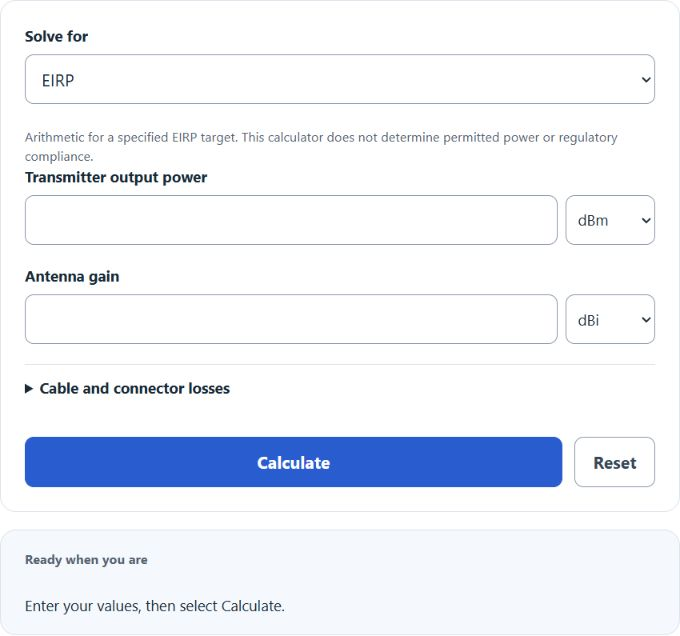
Calculate antenna EIRP from transmitter power, cable loss, and antenna gain, or solve for the required transmit power or maximum antenna gain, with results in dBm, dBW, watts, and ERP.
Antenna EIRP Formula
EIRP (effective isotropic radiated power) is calculated in the decibel domain, so gains are added and losses are subtracted:
EIRP = Pt - Lc + Ga
Variables:
- EIRP is the effective isotropic radiated power, in dBm
- Pt is the transmitter output power, in dBm
- Lc is the total loss between the transmitter and the antenna (cable plus connectors), in dB
- Ga is the antenna gain, in dBi
The calculator’s default mode applies this formula directly. The two other solve-for modes rearrange the same equation. “Required transmitter power” solves for Pt when you know the EIRP you need to reach or stay under, and “Maximum antenna gain” solves for Ga when the transmitter power is fixed and you must not exceed an EIRP limit:
Pt = EIRP - Ga + Lc
 Ga = EIRP - Pt + Lc
Three supporting conversions are used for the unit options and the ERP output. Antenna gain given in dBd (relative to a half-wave dipole) is converted to dBi, ERP is derived from EIRP, and dBm values are converted to watts:
Ga(dBi) = Ga(dBd) + 2.15
 ERP = EIRP - 2.15
 P(W) = 10^((P(dBm) - 30)/10)
If you enter transmitter power or target EIRP in watts or milliwatts, the calculator first converts it to dBm, runs the formula, then reports the result in dBm, dBW, and watts.
EIRP Unit Reference
These are power conversions, not permitted operating limits. Regulations may restrict conducted power, spectral density, antenna gain, equipment and operating conditions as well as EIRP. Check the current rules for the exact band and installation, such as 47 CFR 15.247 and 47 CFR 15.407 in the US, or the applicable national rules in Europe.
| EIRP (dBm) | EIRP (dBW) | Equivalent watts |
|---|---|---|
| 0 | -30 | 0.001 |
| 10 | -20 | 0.01 |
| 14 | -16 | 0.02512 |
| 20 | -10 | 0.1 |
| 30 | 0 | 1 |
| 36 | 6 | 3.9811 |
| 40 | 10 | 10 |
| 53 | 23 | 199.5262 |
Typical Coax Cable Loss for the Lc Input
Cable loss is the input most people guess at. These are approximate examples per 100 feet (30.5 m); exact loss depends on cable variant, frequency, temperature and connectors. Use the manufacturer data for your exact cable. The LMR guide lists LMR-400 at about 6.8 dB per 100 feet at 2.5 GHz, so 50 feet gives about 3.4 dB.
| Cable | Loss at 900 MHz | Loss near 2.4–2.5 GHz | Loss at 5.8 GHz |
|---|---|---|---|
| RG-58 | about 14.5 dB | about 30 dB | not recommended |
| RG-8X | about 12.8 dB | about 23 dB | not recommended |
| LMR-240 | 7.6 dB | 12.7 dB | 20.4 dB |
| LMR-400 | 3.9 dB | 6.8 dB | 10.8 dB |
| LMR-600 | 2.5 dB | 4.4 dB | 7.3 dB |
Antenna EIRP Example Problems
Example 1: A 1 W (30 dBm) radio feeds an antenna through a cable with 3 dB of total loss. The antenna has a gain of 9 dBi. EIRP = 30 – 3 + 9 = 36 dBm, which is about 3.98 W. The ERP is 36 – 2.15 = 33.85 dBm. In the default mode, enter 30 dBm, 3 dB, and 9 dBi and the calculator returns 36 dBm.
Example 2: Your band limits you to 36 dBm EIRP, your radio puts out 27 dBm, and the feedline plus connectors lose 2 dB. The maximum gain for that specified EIRP target is Ga = 36 – 27 + 2 = 11 dBi, or 8.85 dBd. Select “Maximum antenna gain,” enter a target EIRP of 36 dBm, a transmitter power of 27 dBm, and 2 dB of loss to confirm the result.
FAQ
What is the difference between EIRP and ERP?
Both describe the same radiated signal against a different reference antenna. EIRP compares your system to an ideal isotropic radiator, while ERP compares it to a half-wave dipole. Because a dipole already has 2.15 dBi of gain, ERP is always 2.15 dB lower than EIRP for the same setup. FCC rules for unlicensed bands are usually written in EIRP, while some broadcast and European short-range-device rules use ERP, so check which one your regulation names before comparing numbers.
Why is the EIRP higher than the transmitter’s output power?
Antenna gain is not amplification. A directional antenna concentrates the same total power into a narrower beam, so a receiver in that beam sees the signal level that a much stronger transmitter would need with an isotropic antenna. EIRP reports that equivalent power. No extra energy is created, which is why EIRP can legitimately exceed the radio’s output rating without violating physics.
How do I lower my EIRP to stay under a legal limit?
You have three levers. First, reduce the transmitter output power in the radio’s settings, which lowers EIRP dB for dB. Second, switch to a lower-gain antenna. Third, add attenuation between the radio and antenna, either with an inline attenuator or simply by accepting more cable loss. Use the calculator’s “Required transmitter power” mode to estimate the output power corresponding to the specified target for your antenna and cable. This alone does not verify compliance with all applicable limits.