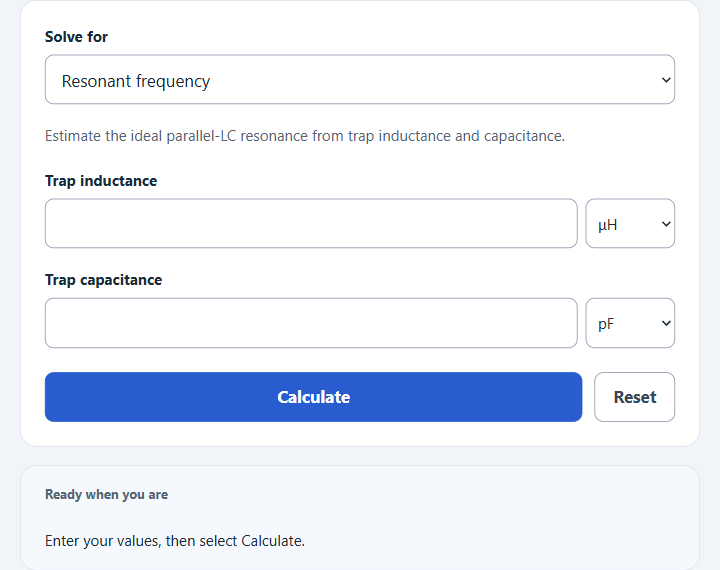
Calculate antenna trap resonant frequency, inductance, or capacitance from any two values in MHz, kHz, GHz, μH, mH, H, or pF, nF, μF.
Related Calculators
- Db Loss Calculator
- Antenna EIRP Calculator
- Line of Sight Calculator
- Angle Of Arrival Calculator
- Time Domain To Phasor Calculator
- All Physics Calculators
Antenna Trap Formula
An antenna trap is a parallel resonant LC circuit. At its resonant frequency, the inductance and capacitance combine to create a high impedance that can isolate part of an antenna element for multiband operation.
Using the calculator base units of MHz, μH, and pF, the main resonance formula is:
To solve for inductance:
To solve for capacitance:
- f = resonant frequency in MHz
- L = trap inductance in μH
- C = trap capacitance in pF
- 159.154943 = unit-adjusted form of 1 / (2π) for MHz, μH, and pF
- 25330.2959 = 159.154943 squared
The frequency function calculates the resonant frequency when you enter inductance and capacitance. The inductance function calculates the required coil value when you enter a target frequency and capacitor value. The capacitance function calculates the required capacitor value when you enter a target frequency and coil value. The calculator converts kHz, MHz, GHz, μH, mH, H, pF, nF, and μF into the base units before applying the formula.
Common Trap Frequency Ranges and LC Products
The same resonant frequency can be made from many different L and C combinations. The LC product is useful because any pair with the same product will resonate at about the same frequency, before real-world stray capacitance and coil effects are considered.
| Amateur band area | Approximate frequency | Required L × C product | Example pair |
|---|---|---|---|
| 40 m | 7.15 MHz | about 496 μH·pF | 5.0 μH and 99 pF |
| 30 m | 10.125 MHz | about 247 μH·pF | 3.0 μH and 82 pF |
| 20 m | 14.2 MHz | about 126 μH·pF | 2.0 μH and 63 pF |
| 15 m | 21.2 MHz | about 56 μH·pF | 1.2 μH and 47 pF |
| 10 m | 28.5 MHz | about 31 μH·pF | 0.8 μH and 39 pF |
Unit Conversion Reference
| Quantity | Unit | Equivalent calculator base unit |
|---|---|---|
| Frequency | 1 kHz | 0.001 MHz |
| Frequency | 1 GHz | 1000 MHz |
| Inductance | 1 mH | 1000 μH |
| Inductance | 1 H | 1,000,000 μH |
| Capacitance | 1 nF | 1000 pF |
| Capacitance | 1 μF | 1,000,000 pF |
Example Calculations
Example 1: Find the resonant frequency
You have a trap with a 2.5 μH coil and a 100 pF capacitor.
The trap resonates at about 10.07 MHz.
Example 2: Find the capacitor value
You want a trap resonant at 14.2 MHz using a 2.0 μH coil.
You would need about 62.8 pF before allowing for stray capacitance and final adjustment.
FAQs
Is an antenna trap exactly resonant at the calculated value?
Not always. The formula gives the ideal LC resonance. A real trap also has coil self-capacitance, lead length, capacitor tolerance, nearby wire effects, and enclosure effects. You should treat the calculated value as a starting point and tune the trap with measurement equipment if the final frequency matters.
Should a trap use high or low inductance?
Either can produce the same resonant frequency if the capacitance is adjusted to match. Higher inductance usually means a larger coil and may add more loss or stray capacitance. Lower inductance usually requires more capacitance. For transmitting antennas, you also need parts that can handle the RF current and voltage at your power level.
Why do I need to enter exactly two values?
The trap resonance equation has three variables: frequency, inductance, and capacitance. Select the unknown under Solve for, then enter the other two values. Only the two required inputs are shown for the selected calculation.