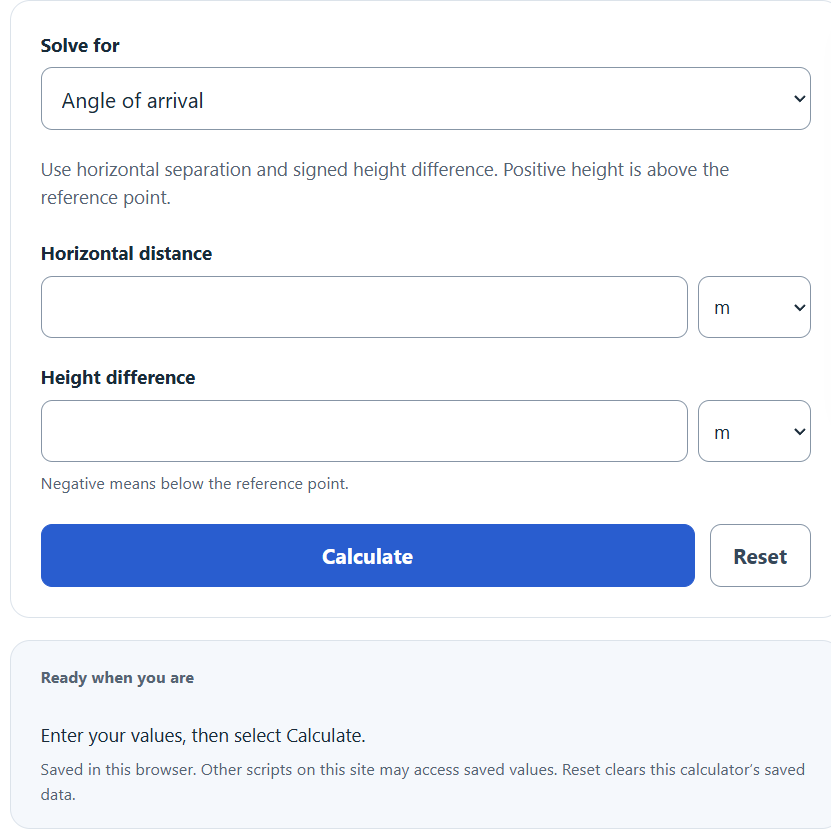
Calculate angle of arrival, distance, or height from any two values using trigonometry with meters, feet, miles, centimeters, or inches.
Related Calculators
- Antenna Axial Ratio Calculator
- Electrical Length Calculator
- RF Gain Calculator
- Link Margin Calculator
- All Physics Calculators
Angle Of Arrival Formula
The angle of arrival is found from a right triangle using the horizontal distance and the height difference. Select Angle of arrival, Height difference, or Horizontal distance, then enter the other two values. Heights and angles are signed; horizontal distance is nonnegative.
- θ = angle of arrival, in degrees
- h = height difference between the two points
- d = horizontal distance between the two points
- π = pi, approximately 3.14159
- tan = tangent function
- tan-1 = inverse tangent, also called arctangent
If you enter distance and height, the calculator uses inverse tangent to find the angle. If you enter distance and angle, it uses tangent to find the height. If you enter height and angle, it rearranges the tangent formula to find the distance.
Distance and height can be entered in different units. The calculation converts them to meters internally, then converts a missing length to the selected Answer unit.
Common Angle Ratios
These tangent values show how the angle changes as height becomes larger compared with distance.
| Angle | tan(θ) | Meaning |
|---|---|---|
| 5° | 0.0875 | Height is about 8.75% of the distance |
| 10° | 0.1763 | Height is about 17.63% of the distance |
| 30° | 0.5774 | Height is about 57.74% of the distance |
| 45° | 1.0000 | Height equals distance |
| 60° | 1.7321 | Height is about 1.73 times the distance |
Length Unit Conversions Used
| Unit | Meters per unit |
|---|---|
| Centimeter (cm) | 0.01 m |
| Inch (in) | 0.0254 m |
| Foot (ft) | 0.3048 m |
| Meter (m) | 1 m |
| Kilometer (km) | 1000 m |
| Mile (mi) | 1609.344 m |
Example Problems
Example 1: Find the angle of arrival
You have a height difference of 20 m and a horizontal distance of 100 m.
The angle of arrival is about 11.31°.
Example 2: Find the height
You have a distance of 250 ft and an angle of arrival of 8°.
The height difference is about 35.14 ft.
FAQ
What does angle of arrival mean?
Angle of arrival is the angle at which a line, signal, ray, or path reaches a point compared with a horizontal reference line. In this calculator, it is treated as the angle of a right triangle formed by horizontal distance and height difference.
Do distance and height need to use the same unit?
No. You can enter distance and height in different units. The calculator converts both lengths to meters for the calculation. For a missing distance or height, select the Answer unit.
Can the horizontal distance be zero?
Yes. With nonzero height, zero horizontal distance gives a vertical angle of +90° or -90°. Two coincident points do not define an angle. Height solving requires positive horizontal distance and an angle strictly between -90° and +90°.