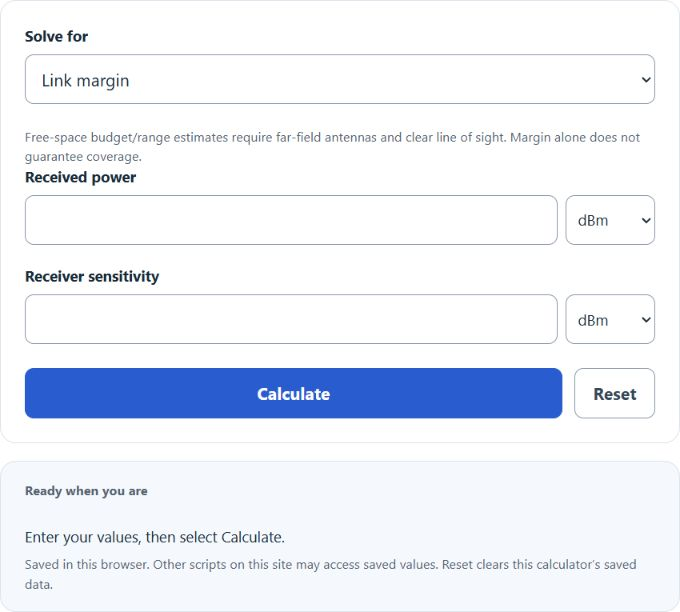
Calculate wireless link margin, link budget, receiver sensitivity, and max distance from power, gain, loss, frequency, and bandwidth.
Related Calculators
- Received Power Calculator
- Receiver Sensitivity Calculator
- RF Gain Calculator
- dB to Linear Converter
- dB to Ratio Calculator
- Resistor Noise Calculator
- All Physics Calculators
Link Margin Formula
The following equation is used to calculate the Link Margin.
- Where LM is the link margin (dB)
- RSL is the received signal level (dBm, or dBW with the same reference as MRL)
- MRL is the minimum required level (dBm, or dBW with the same reference as RSL)
To calculate the link margin, subtract the minimum required level from the received signal level.
What is a Link Margin?
Definition:
Link margin refers to the difference between a signal’s strength at the receiver and the minimum power level necessary for reliable data transmission. It measures headroom against an entered threshold; actual reliability also depends on interference, fading and receiver requirements.
How to Calculate Link Margin?
Example Problem:
The following example outlines the steps and information needed to calculate the Link Margin.
First, determine the received signal level (RSL). In this example, the RSL is -60 dBm.
Next, determine the minimum required level (MRL) for reliable communication, which is -75 dBm.
Finally, calculate the link margin using the formula above:
LM = RSL – MRL
LM = (-60 dBm) – (-75 dBm)
LM = 15 dB
FAQ
What factors can affect the link margin?
The link margin can be influenced by path losses, interference, fading, obstacles, and even weather conditions. Changes in any of these factors can either reduce or increase the effective margin.
How can I improve my link margin?
You can improve your link margin by increasing the transmitter power, using higher-gain antennas, reducing interference, and ensuring clear line-of-sight conditions. Proper alignment and regular equipment maintenance are also crucial.
Why is link margin important for reliable communication?
Link margin provides a buffer against variations in signal strength that can occur in real-world operating conditions. Adequate design margin helps tolerate signal variation, but the required margin depends on propagation conditions and the receiver’s performance target.