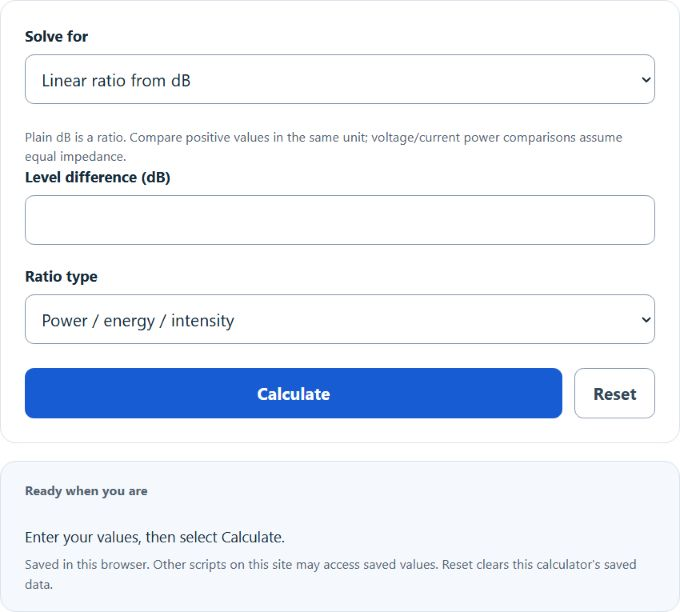
Convert decibels to linear power, intensity, voltage, current, or amplitude ratios, reverse a ratio to dB, or compare two positive signal values.
dB to Ratio Formula
The conversion depends on whether the quantity is a power-like quantity (watts, mW) or an amplitude-like quantity (volts, pascals, current).
- dB — decibel value
- P, P0 — output and reference power
- V, V0 — output and reference amplitude (voltage, pressure, etc.)
Use 10 for power, energy and intensity ratios, or 20 for amplitude ratios. Voltage/current amplitude ratios represent power gain under equal impedance. Enter positive compared and reference values in the same unit; plain dB is a relative level.
Reference Tables
Common dB values and their linear equivalents.
| dB | Power Ratio | Amplitude Ratio |
|---|---|---|
| −20 | 0.01 | 0.1 |
| −10 | 0.1 | 0.316 |
| −6 | 0.251 | 0.501 |
| −3 | 0.501 | 0.708 |
| 0 | 1 | 1 |
| 3 | 1.995 | 1.413 |
| 6 | 3.981 | 1.995 |
| 10 | 10 | 3.162 |
| 20 | 100 | 10 |
| 30 | 1,000 | 31.62 |
| 60 | 1,000,000 | 1,000 |
Which formula applies depends on the quantity. If you pick the wrong one, your result is off by a factor of two in dB.
| Quantity | Type | Use |
|---|---|---|
| Power, intensity, energy | Power | 10·log₁₀ |
| Voltage, current | Amplitude | 20·log₁₀ |
| Sound pressure (SPL) | Amplitude | 20·log₁₀ |
| Antenna gain, signal-to-noise | Power | 10·log₁₀ |
Worked Examples
Convert 14 dB to a power ratio.
ratio = 10^(14/10) = 10^1.4 ≈ 25.12. A 14 dB amplifier puts out about 25× the input power.
Convert a voltage ratio of 4 to dB.
dB = 20·log₁₀(4) ≈ 12.04 dB. Its corresponding power gain assumes equal impedance.
Find the dB drop from 50 W to 5 W.
dB = 10·log₁₀(5/50) = 10·log₁₀(0.1) = −10 dB.
FAQ
Why 10 for power and 20 for amplitude? Power is proportional to amplitude squared. The factor of 2 from the squaring moves outside the log and doubles the coefficient.
Can dB be negative? Yes. Negative dB means the output is smaller than the reference. −3 dB is roughly half power.
What does 0 dB mean? The ratio is exactly 1. The output equals the reference.
Is dB the same as dBm or dBW? No. Plain dB is a ratio. dBm and dBW are absolute levels referenced to 1 mW and 1 W.