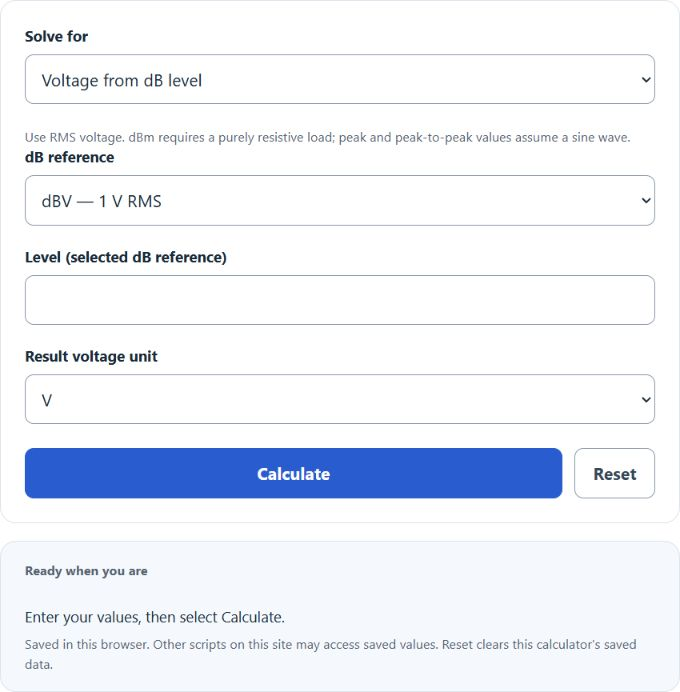
Convert between RMS voltage and dBV, dBu, a custom voltage reference, or dBm across a purely resistive load. Voltage units include V, mV, µV and kV.
- All Unit Converters
- Waves, Optics, and Quantum Unit Converters
- Electricity, Magnetism, & Electronics Unit Converters
- All Electrical Calculators
- DB to Watts Calculator
- dB Gain Calculator
- Attenuation Calculator
- dBm to RMS Voltage Calculator
Voltage from dB Formula
For dBV, the reference is 1 V RMS and the following formula gives RMS voltage. For dBu or a custom voltage reference, use V = Vref × 10^(L/20), with Vref = 0.775 V RMS for dBu. Plain dB alone does not specify an absolute voltage.
Variables:
- Where V is the Voltage from dB (volts)
- dBV is the voltage level relative to 1 V RMS
For dBV, raise 10 to the power of the level divided by 20. The reverse is L = 20 log10(V/Vref). For dBm, P(W) = 0.001 × 10^(dBm/10) and Vrms = √(P × R), where R is the positive purely resistive load in ohms. Sine-wave peak and peak-to-peak values are √2 and 2√2 times RMS; these factors do not apply to arbitrary waveforms. Interpreting a custom voltage gain as power gain assumes equal impedances.
| dBV | Volts (V) |
|---|---|
| -60 | 0.001000 |
| -50 | 0.003162 |
| -40 | 0.010000 |
| -30 | 0.031623 |
| -24 | 0.063096 |
| -20 | 0.100000 |
| -18 | 0.125893 |
| -12 | 0.251189 |
| -10 | 0.316228 |
| -6 | 0.501187 |
| -3 | 0.707946 |
| -1 | 0.891251 |
| 0 | 1.000000 |
| 1 | 1.122018 |
| 3 | 1.412538 |
| 6 | 1.995262 |
| 10 | 3.162278 |
| 12 | 3.981072 |
| 20 | 10.000000 |
| 40 | 100.000000 |
| * Rounded to 6 decimals. Reference: 0 dBV = 1 V (RMS). Formula: V = 10^(dBV/20). | |
How to Calculate Voltage from dB?
The following two example problems outline the steps and information needed in order to calculate the Voltage from dB.
Example Problem #1:
- First, determine the total dBV (decibel volts). In this example, the total dBV (decibel volts) is measured to be 14.
- Finally, calculate the Voltage from dB using the formula above:
V = 10 ^ (dBV / 20)
Inserting the values from above into the equation yields:
V = 10 ^ (14/20) ≈ 5.0119 V RMS
Example Problem #2:
Using the same process as the first example, define the variables outlined by the formula. In this case, these values are:
total dBV (decibel volts) = 100
Entering these values into the formula or calculator above gives us
V = 10 ^ (100 / 20) = 100,000 (volts)