Calculate remaining signal, attenuation in dB, or distance to a target level for power or amplitude with coefficient and distance conversions plus half-level range.
- All Physics Calculators
- All Electrical Calculators
- Decibel Calculator
- RMS Voltage (VRMS) Calculator
- Output Voltage Calculator
- dB Per Inch Calculator
Attenuation Formula
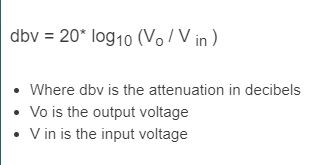
Choose remaining output, attenuation, or distance to a target level. Power uses A = 10 log₁₀(input/output); amplitude uses A = 20 log₁₀(input/output). With a constant loss coefficient α, A = α × distance and distance = A / α. The voltage identities below describe the same amplitude relationship.
- A = attenuation in decibels, dB
- V_in = input voltage
- V_out = output voltage after attenuation
- log_10 = base-10 logarithm
Both signal levels use the same selected linear unit: W or mW for power, V or mV for amplitude, or explicit generic units. Coefficient and distance unit selectors convert the entered quantity.
- Find attenuation: use input voltage and output voltage to calculate the dB loss.
- Find output voltage: use the initial level, coefficient and distance to calculate the remaining level.
- Find distance: use the initial and target levels with a positive coefficient. A zero-loss coefficient does not define a unique target distance.
Common Voltage Attenuation Ratios
These values show how common attenuation levels compare to voltage ratios.
| Attenuation | Voltage Ratio Vout / Vin | Meaning |
|---|---|---|
| 0 dB | 1.000 | No attenuation |
| 3 dB | 0.708 | Output voltage is about 70.8% of input |
| 6 dB | 0.501 | Output voltage is about half of input |
| 10 dB | 0.316 | Output voltage is about 31.6% of input |
| 20 dB | 0.100 | Output voltage is one-tenth of input |
| 40 dB | 0.010 | Output voltage is one-hundredth of input |
| Unit | Equivalent in Volts | Example |
|---|---|---|
| mV | 0.001 V | 500 mV = 0.5 V |
| V | 1 V | 2 V = 2 V |
| kV | 1000 V | 1.5 kV = 1500 V |
Example Problems
Example 1: Calculate attenuation
You have an input voltage of 10 V and an output voltage of 1 V.
The attenuation is 20 dB.
Example 2: Calculate output voltage
Choose amplitude, 5 V input, a coefficient of 6 dB/km and a distance of 1 km, giving total attenuation of 6 dB.
The output voltage is about 2.506 V.
FAQ
Why does the formula use 20 instead of 10?
Voltage attenuation uses 20 log because voltage is a field quantity. Power ratios use 10 log. If you are comparing voltages across the same impedance, the voltage dB formula is:
Can attenuation be negative?
The formula can describe gain as negative attenuation: 1 V input and 2 V output gives about −6.02 dB. This distributed-loss calculator models attenuation only, so output above input is rejected.
Do input and output voltage need to use the same unit?
Yes. Use the same selected linear signal unit for both levels. The voltage conversion table above is a reference; this calculator does not accept separate units for the two signal levels.