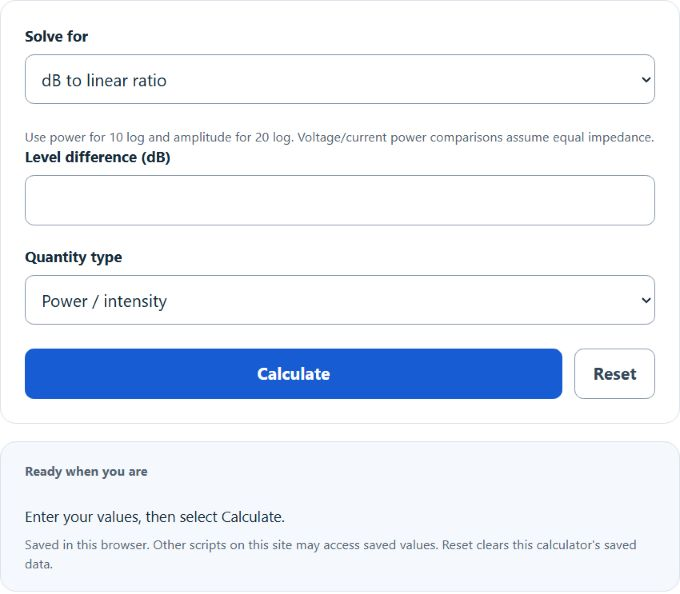
Calculate the linear ratio from a dB value for power, intensity, amplitude, or voltage with 10·log₁₀ or 20·log₁₀ conversion formulas.
Quick overview: dB to linear
Decibels express ratios on a logarithmic scale. To convert back to a linear ratio, use 10^(dB/10) for power or intensity and 10^(dB/20) for voltage, amplitude, or sound pressure style quantities.
- 0 dB = 1× ratio
- 3 dB ≈ 2× power
- 6 dB ≈ 2× amplitude or voltage
- 10 dB = 10× power
- -10 dB = 0.1× power
The calculator automatically applies the correct formula based on the selected quantity type.
- cm To Ratio Calculator
- Mbps To Hz Calculator
- Lumens To Lux Distance Calculator
- Energy to Wavelength Calculator
- All Unit Converters
dB to Linear Formula
The following formulas are used to convert decibels into linear ratios depending on the type of quantity being measured.
Variables:
- R is the linear ratio
- dB is the value in decibels
- Use 10 in the denominator for power or intensity ratios
- Use 20 in the denominator for voltage, amplitude, or sound pressure ratios
To calculate the linear ratio, raise 10 to the power of the decibel value divided by either 10 or 20, depending on the quantity type. Voltage/current amplitude ratios correspond to power gain only when the impedances are equal.
What is dB to Linear Conversion?
dB to linear conversion is the process of converting a logarithmic decibel value into a direct multiplicative ratio. Since decibels are logarithmic, equal changes in dB represent multiplication or division in linear terms rather than simple addition or subtraction. This is useful in electronics, acoustics, telecommunications, RF systems, and signal processing, where gains and losses are often expressed in dB but need to be interpreted as actual ratios.
For power-like quantities such as electrical power or acoustic intensity, the conversion uses 10^(dB/10). For amplitude-like quantities such as voltage, current, and sound pressure, the conversion uses 10^(dB/20). A value of 0 dB always corresponds to a ratio of 1, meaning no change.
How to Convert dB to Linear?
The following steps outline how to convert decibels to a linear ratio.
- First, determine the value in decibels (dB).
- Next, identify whether the dB value refers to a power or intensity ratio, or to an amplitude or voltage ratio.
- If it is a power or intensity quantity, calculate the ratio using R = 10^(dB/10).
- If it is an amplitude or voltage quantity, calculate the ratio using R = 10^(dB/20).
- After inserting the values and calculating the result, check your answer with the calculator above.
dB to Linear Conversion Table
The table below lists common decibel values and their corresponding linear ratios for both power and amplitude-based quantities.
| Level (dB) | Power Ratio (10^(dB/10)) | Amplitude Ratio (10^(dB/20)) |
|---|---|---|
| 0 dB | 1.00 | 1.00 |
| 3 dB | 2.00 | 1.41 |
| 6 dB | 3.98 | 2.00 |
| 10 dB | 10.00 | 3.16 |
| 20 dB | 100.00 | 10.00 |
| -3 dB | 0.50 | 0.71 |
| -10 dB | 0.10 | 0.32 |
In practice, engineers and technicians frequently move between dB and linear ratios when analyzing gains, losses, signal levels, amplifier performance, and acoustic measurements. Understanding the correct formula makes it much easier to interpret logarithmic values as direct “times bigger” or “times smaller” changes.
Example Problem:
Use the following values as an example problem to test your knowledge.
Value in dB = 6
Quantity Type = Voltage Ratio
Using the formula R = 10^(dB/20), the linear ratio is approximately 1.995.