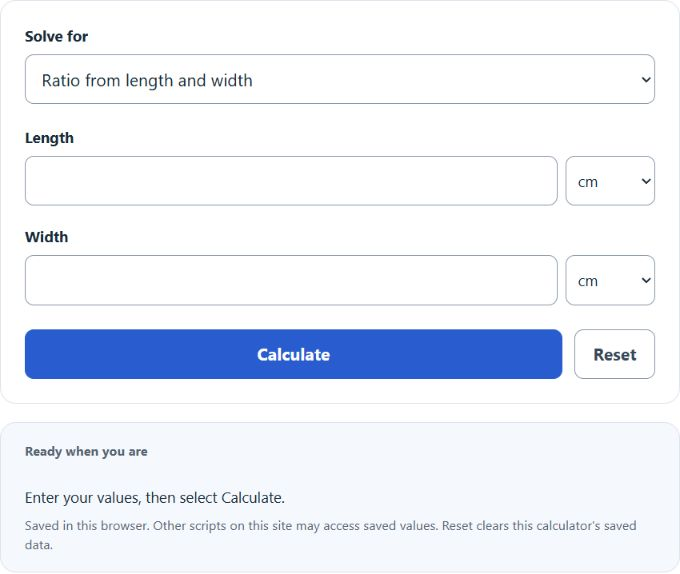
Calculate a length-to-width ratio from measurements in centimeters, meters, millimeters, inches, or feet, or solve a missing dimension from a known ratio.
- All Unit Converters
- cm to Pixel Calculator
- Scale Calculator
- Scaling Down Calculator
- Scale Factor Dilation Calculator
- Decimal to Ratio Calculator
- Similarity Ratio Calculator
cm to Ratio Formula
The calculator converts both measurements to centimeters first, then divides the converted length by the converted width.
- L = length value entered
- W = width value entered
- C_L = conversion factor for the selected length unit
- C_W = conversion factor for the selected width unit
- L_cm = length converted to centimeters
- W_cm = width converted to centimeters
- R = length-to-width ratio
The length and width can be entered in centimeters, meters, millimeters, inches, or feet. The calculator converts each value to centimeters so the ratio compares like units. The final result is the converted length divided by the converted width, shown as a decimal ratio.
Unit Conversion Factors to Centimeters
These are the conversion factors used before the ratio is calculated.
| Unit | Symbol | Centimeter Conversion |
|---|---|---|
| Centimeter | cm | 1 cm = 1 cm |
| Meter | m | 1 m = 100 cm |
| Millimeter | mm | 1 mm = 0.1 cm |
| Inch | in | 1 in = 2.54 cm |
| Foot | ft | 1 ft = 30.48 cm |
Common Length-to-Width Ratio Meanings
| Result | Meaning |
|---|---|
| 1.0000 | Length and width are equal. |
| Greater than 1 | Length is greater than width. |
| Less than 1 | Length is less than width. |
| 2.0000 | Length is twice the width, often written as 2:1. |
Example Calculations
Example 1: Same units
Suppose the length is 30 cm and the width is 10 cm.
The ratio is 3.0000, which can also be written as 3:1.
Example 2: Different units
Suppose the length is 2 m and the width is 50 cm.
The ratio is 4.0000, or 4:1.
FAQ
What does the ratio result mean?
The result tells you how many times the width fits into the length. For example, a result of 2.0000 means the length is twice the width. A result of 0.5000 means the length is half the width.
Can I enter different units for length and width?
Yes. You can enter length and width in different units. The calculator converts both values to centimeters first, then divides the converted length by the converted width.
Why can the width not be zero?
The ratio is calculated by dividing length by width. Division by zero is undefined, so the width must be greater than zero to calculate a valid ratio.