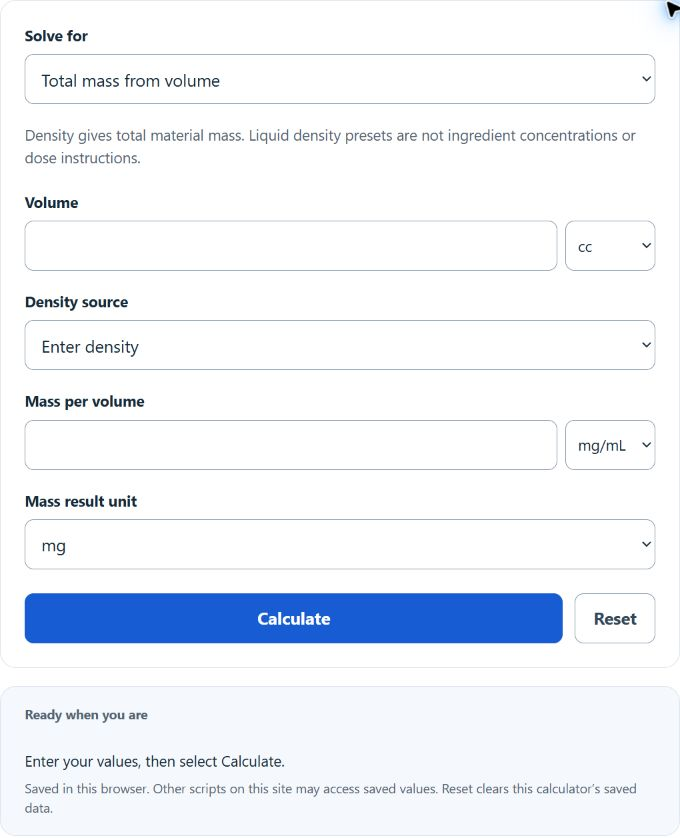
Convert cc, cm³, mL or L to mg, g or kg and back. Use total material density for total mass, or the exact labeled ingredient concentration for ingredient mass. Approximate liquid density presets are not medication concentrations or dose instructions. Saline needs composition-specific custom density.
cm³ To mg Formula
The following formula is used to calculate the mass in milligrams from volume in cubic centimeters.
Variables:
- M is the mass in milligrams (mg)
- V is the volume in cubic centimeters (cm^3)
- D is the density of the substance (mg/cm^3)
To calculate the mass in milligrams, multiply the volume in cubic centimeters by the density of the substance in milligrams per cubic centimeter.
| Volume (cc) | Equivalent (mL) | Mass (mg) |
|---|---|---|
| 0.1 | 0.1 | 100 |
| 0.25 | 0.25 | 250 |
| 0.5 | 0.5 | 500 |
| 1 | 1 | 1000 |
| 2 | 2 | 2000 |
| 5 | 5 | 5000 |
| 10 | 10 | 10000 |
| 20 | 20 | 20000 |
| 50 | 50 | 50000 |
| 100 | 100 | 100000 |
| * This table assumes a density of 1.00 g/cc, approximately water. Formula: mg = cc × density (g/cc) × 1000. For other substances, the mg value will change based on density. | ||
What is cm³ To mg?
Cm to Mg refers to the conversion from centimeters to milligrams. However, this is not a standard conversion as centimeters measure length while milligrams measure mass. A direct conversion between these two units is not possible without additional information such as density of a specific substance. For example, if you know the density of a substance, you can calculate its mass in milligrams from its volume in cubic centimeters.
How to Calculate cm³ To mg?
The following steps outline how to calculate the cm³ To mg using the formula M = V * D.
- First, determine the volume in cubic centimeters (V).
- Next, determine the density of the substance (D).
- Next, gather the formula from above = M = V * D.
- Finally, calculate the mass in milligrams (M).
- After inserting the variables and calculating the result, check your answer with the calculator above.
Example Problem:
Use the following variables as an example problem to test your knowledge.
Volume (V) = 5 cm³
Density (D) = 2 mg/cm³; total mass = 5 × 2 = 10 mg. If 2 is an ingredient concentration in mg/mL, the same calculation gives that ingredient’s mass instead of total solution mass.