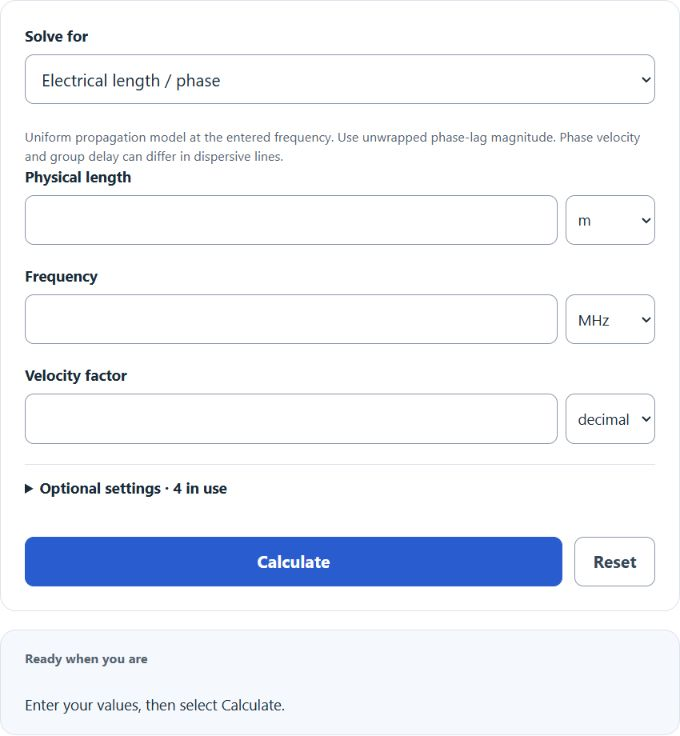
Calculate electrical length, phase shift, wavelength, and time delay from physical length, frequency, and velocity factor, or vice versa.
Electrical Length Formula
The electrical length is the physical length of a line expressed as a fraction of a wavelength at a given frequency. The calculator uses the speed of light adjusted by the velocity factor of the line.
- L = physical length of the line
- f = frequency in hertz
- VF = velocity factor as a decimal
- c = speed of light, 299,792,458 m/s
- λ = wavelength in the line
- N = electrical length in wavelengths, also called turns
- θdeg = phase or electrical length in degrees
- θrad = phase or electrical length in radians
Choose the quantity to solve and enter the three known values. The missing value is found by rearranging the same wavelength and phase equations. The four-known-values mode reports entered minus predicted phase.
The Phase & Delay mode accepts usable known pairs and rejects inconsistent supplied values. Time delay comes from line length and propagation speed, while phase lag comes from frequency and delay. These equations assume uniform propagation; phase velocity and group delay can differ in dispersive lines.
- t = one-way time delay in seconds
- Length and velocity factor can solve delay.
- Phase and frequency can solve delay.
- Delay and frequency can solve phase shift.
- Delay and velocity factor can solve physical length.
Common Velocity Factors and Phase References
Use the cable or transmission-line datasheet when possible. The values below are typical starting points.
| Line or medium | Typical velocity factor | Notes |
|---|---|---|
| Free space | 1.00 | Use for an ideal wave in air or vacuum approximation. |
| Air-spaced line | 0.95 to 0.99 | Common for open-wire or low-dielectric structures. |
| Solid PE coax | 0.66 | Common value for many solid polyethylene coaxial cables. |
| Foam PE coax | 0.78 to 0.88 | Varies by foam density and cable design. |
| PTFE coax | 0.69 to 0.71 | Often used in higher-temperature or precision cables. |
| Twisted pair cable | 0.64 to 0.72 | Depends on insulation, twist rate, and cable category. |
| Electrical length | Degrees | Radians | Common name |
|---|---|---|---|
| 0.125 λ | 45° | π/4 | Eighth-wave |
| 0.25 λ | 90° | π/2 | Quarter-wave |
| 0.5 λ | 180° | π | Half-wave |
| 1.0 λ | 360° | 2π | Full wavelength |
Electrical Length Examples
Example 1: Find the electrical length of a coax line
You have a 2 m cable, a frequency of 100 MHz, and a velocity factor of 0.66.
The electrical length is about 363.888°, or 1.010800 wavelengths. The normalized phase is about 3.888°.
Example 2: Find delay and length from phase
You need a 90° phase shift at 50 MHz. A 90° shift is 0.25 wavelengths.
The delay is 5 ns.
If the velocity factor is 0.80, the physical length is:
The required line length is about 1.199 m.
Electrical Length FAQ
What is the difference between physical length and electrical length?
Physical length is the measured length of the cable, trace, antenna element, or transmission line. Electrical length tells you how long that same object is compared with the wavelength of the signal traveling through it. A short physical line can be a large electrical length at high frequency.
Why does velocity factor matter?
Signals usually travel slower in cable or dielectric material than they do in free space. Velocity factor accounts for that slower propagation speed. A lower velocity factor makes the wavelength inside the line shorter, so the same physical length becomes a larger electrical length.
Why can the normalized phase be different from the total electrical length?
Total electrical length keeps counting past 360°. For example, 450° means 1.25 wavelengths. Normalized phase reduces the result to one 0° to 360° cycle, so 450° becomes 90°. Both values are useful, but they answer different questions.