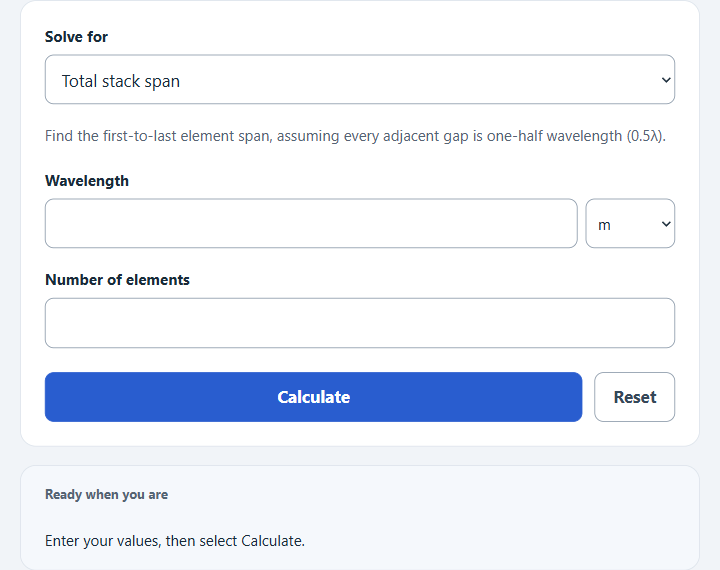
Calculate antenna stacking distance, wavelength, or number of elements from the other two values using 0.5λ adjacent spacing for arrays.
Related Calculators
- RF Average Power to Peak Power Calculator
- Antenna EIRP Calculator
- Phase Difference Calculator
- Fundamental Frequency Calculator
- Electric Field Calculator
- All Physics Calculators
Antenna Stacking Distance Formula
The calculator assumes adjacent antenna elements are spaced at one-half wavelength, or 0.5λ. With that assumption, the total stack span is the distance from the first element to the last element.
- D = total stack span, measured from the first antenna element to the last antenna element
- λ = wavelength
- N = number of antenna elements in the stack
When you select Total Stack Span under Solve for, the calculator uses the wavelength and number of elements to find the required overall span.
When you select Wavelength under Solve for, the calculator uses the total stack span and number of elements to find the wavelength implied by 0.5λ spacing.
When you select Number of Elements under Solve for, the calculator uses the wavelength and total stack span to estimate the number of elements. Since element count must be a whole number, the result is rounded to the nearest whole number.
Common 0.5λ Stack Spans by Element Count
The table below shows the total stack span as a multiple of wavelength when adjacent element spacing is 0.5λ.
| Number of Elements | Number of Gaps | Total Stack Span |
|---|---|---|
| 2 | 1 | 0.5λ |
| 3 | 2 | 1.0λ |
| 4 | 3 | 1.5λ |
| 5 | 4 | 2.0λ |
| 6 | 5 | 2.5λ |
Length Unit Conversions Used
| Unit | Meters Equivalent |
|---|---|
| 1 meter | 1 m |
| 1 centimeter | 0.01 m |
| 1 millimeter | 0.001 m |
| 1 inch | 0.0254 m |
| 1 foot | 0.3048 m |
Example Problems
Example 1: Find total stack span
You have a wavelength of 2 meters and 4 antenna elements.
The total stack span is 3 meters.
Example 2: Find wavelength
You have a total stack span of 6 feet and 5 antenna elements.
The wavelength is 3 feet.
FAQ
What does total stack span mean?
Total stack span is the distance from the first antenna element to the last antenna element. It is not the spacing between two adjacent elements unless there are only two elements. For example, with 4 elements, there are 3 gaps between elements.
Why does the formula use N minus 1?
The number of spaces between elements is one less than the number of elements. A 2-element stack has 1 space, a 3-element stack has 2 spaces, and a 4-element stack has 3 spaces. Since each adjacent space is assumed to be 0.5λ, the total span is 0.5λ times N minus 1.
Why is the number of elements rounded?
You cannot have a fractional antenna element in the stack. When calculating N from wavelength and total span, the raw formula may produce a decimal result if the span does not match an exact 0.5λ spacing pattern. The calculator rounds that value to the nearest whole number and shows the resulting span and its difference from the entered span. A rounded count may not be an exact fit.