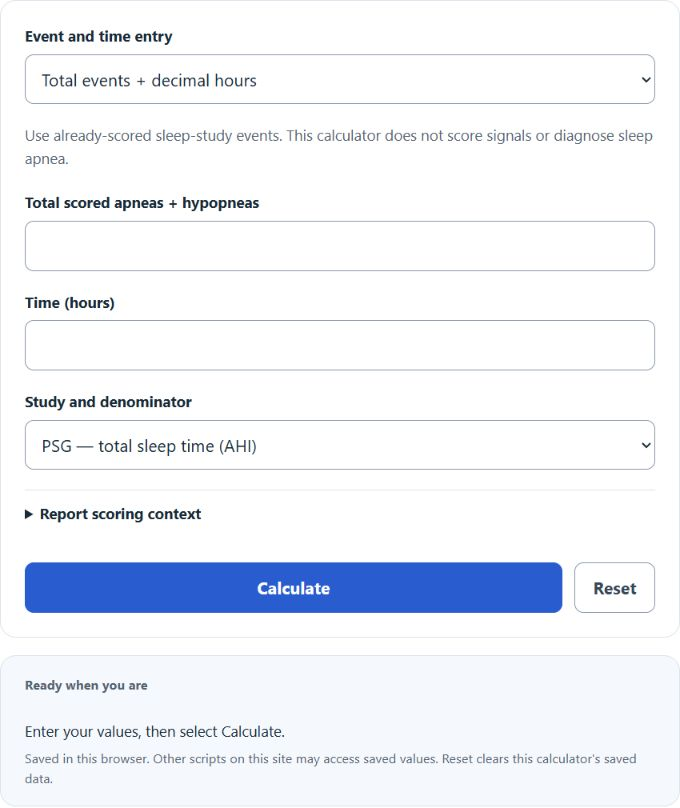
Calculate a PSG apnea-hypopnea index from scored events and total sleep time, or an HSAT respiratory event index from scored events and monitoring time. The calculator does not score events or diagnose sleep apnea.
Apnea-Hypopnea Index Formula
The apnea-hypopnea index is the number of already scored apneas and hypopneas divided by total sleep time measured during polysomnography. A home sleep apnea test generally uses monitoring time instead and reports a respiratory event index.
PSG AHI = (scored apneas + scored hypopneas) ÷ total sleep time in hours
HSAT REI = (scored apneas + scored hypopneas) ÷ monitoring time in hours
Hours = minutes ÷ 60
Both results are expressed as events per hour. The calculator accepts only whole-number event counts because the events should already have been scored from a study. It does not inspect airflow, effort, oxygen, or arousal signals and cannot decide whether a raw breathing change meets a scoring rule.
Variables and Time Bases
| Item | What to Enter | Result |
|---|---|---|
| PSG | Scored apneas + hypopneas and total sleep time | AHI, events/hour |
| HSAT | Scored apneas + hypopneas and monitoring time | REI, events/hour |
| Event count | A whole number of zero or greater, entered as a total or as separate apnea and hypopnea counts | Numerator |
| Time | Positive decimal hours or whole hours plus 0–59 minutes | Denominator |
| Scoring context | The hypopnea definition shown on the report, if known | Recorded label only; it does not change the count |
What Do AHI and REI Measure?
AHI is a frequency: how often scored apneas and hypopneas occurred per hour of measured sleep. In an attended PSG, sleep stages are identified from physiologic signals, allowing total sleep time to be used as the denominator. AHI is therefore not simply “events per night.” Two studies with the same event count can have different AHI values if their measured sleep times differ.
Most HSAT systems do not measure sleep with the same set of signals as PSG. Their denominator is generally monitoring time or another device-defined recording interval, so the result should be labeled REI rather than AHI. Monitoring time can exceed true sleep time. Dividing by a longer denominator may produce a lower frequency than would be calculated from actual sleep time, one reason PSG AHI and HSAT REI should not be treated as interchangeable.
How to Use the AHI and REI Calculator
- Select PSG when the denominator is total sleep time from polysomnography. Select HSAT when the report uses monitoring time; the calculator will label that output REI.
- Choose a total event count or separate apnea and hypopnea counts. Copy whole-number counts from the report rather than estimating them from a symptom diary or device graph.
- Enter the matching denominator in decimal hours or hours and minutes. Do not combine events from one interval with time from another.
- Record the report’s hypopnea scoring context if it is known. The selector documents the definition but does not add, remove, or rescore events.
- Calculate and preserve the study type, time basis, scoring rule, and technical interpretation with the numeric index.
Worked AHI and REI Examples
A PSG report lists 42 scored apneas plus hypopneas and 7.0 hours of total sleep time. The calculation is 42 ÷ 7.0 = 6.0 events/hour, reported as AHI. If the time is written as 7 hours 0 minutes, the result is identical.
Now suppose an HSAT records the same 42 events over 8.0 hours of monitoring time. The result is 42 ÷ 8.0 = 5.25 events/hour, reported as REI. It is not relabeled AHI, and the numerical difference does not mean the person’s breathing changed; the denominator changed. A true zero-event study is valid input and returns zero, provided the study time is positive.
How Apneas and Hypopneas Are Scored
Qualified sleep professionals score respiratory events using defined signals, durations, amplitude changes, oxygen desaturation, arousal, and event-type rules. The AASM recommended adult hypopnea definition recognizes a qualifying airflow reduction associated with at least a 3% oxygen desaturation or an arousal. An acceptable definition using at least a 4% desaturation is also encountered, including in payer-related settings. These definitions can yield different counts from the same recording.
The calculator deliberately uses the count already established by the report. Selecting “3% or arousal,” “4%,” or “unknown” does not change the arithmetic. Users should not attempt to identify events from pulse-oximeter data alone. Obstructive, central, and mixed apneas also have different signal criteria, and the total AHI or REI does not by itself show which type predominates.
Adult Frequency Bands and Diagnostic Context
For adult PSG reporting, commonly used AHI frequency bands are under 5, 5 to under 15, 15 to under 30, and 30 or more events/hour. At exact boundaries, 5 begins the mild band, 15 begins the moderate band, and 30 begins the severe band. Those labels describe event frequency; they are not a complete diagnosis, treatment rule, or measure of every consequence of sleep-disordered breathing.
Obstructive sleep apnea diagnosis requires the appropriate study context and considers whether events are predominantly obstructive, symptoms, relevant comorbidities, and report quality. An AHI below 5 does not prove that every sleep-related breathing disorder is absent. Respiratory-effort-related arousals can affect an RDI even when AHI is lower, while oxygen burden, event duration, sleep stage, body position, and symptoms can add information not captured by a single frequency.
The calculator does not automatically apply an adult band to REI, children, or adolescents. Pediatric severity conventions such as 1, 5, and 10 events/hour are commonly used in research and clinical practice but are not a universal classification for every child. Adult respiratory scoring may be optional for some adolescents ages 13–18, depending on the laboratory and context. Pediatric studies need specialist interpretation.
AHI, RDI, ODI, AI, HI, and CAI
These abbreviations have different numerators or denominators. AI counts apneas per hour; HI counts hypopneas per hour. CAI counts central apneas per hour. PSG RDI can include apneas, hypopneas, and respiratory-effort-related arousals divided by total sleep time. ODI counts qualifying oxygen desaturations divided by its stated observation time and depends on the desaturation rule. None should be substituted for AHI or REI without confirming the report’s definition.
A PAP machine’s displayed “AHI” is also not automatically equivalent to a scored diagnostic or treatment PSG AHI. Devices use manufacturer algorithms, flow-based event detection, and device-recording time; mask leak, wake breathing, and proprietary classification can affect the number. This page therefore has no treatment-success mode and does not calculate how many events are “allowed” under a target.
Limitations and Clinical Follow-Up
AHI and REI vary from night to night and can change with body position, REM sleep, alcohol or medication exposure, nasal obstruction, altitude, and other conditions. A technically inadequate or inconclusive HSAT cannot be made definitive by recalculating its index. AASM diagnostic guidance supports PSG when a single HSAT is negative, inconclusive, or technically inadequate but clinical concern remains.
Discuss the complete sleep-study report with a qualified clinician, particularly when there is loud habitual snoring, witnessed pauses, choking, excessive sleepiness, impaired alertness, resistant hypertension, cardiovascular disease, or persistent concern despite a low or negative result. Urgent symptoms should be handled through appropriate medical care rather than this calculator.
Frequently Asked Questions
Why does the calculator require whole events?
Apneas and hypopneas are discrete scored events. A decimal such as 12.5 events is not a valid report count, although the calculated events-per-hour index may contain decimals.
Can I use time in bed for AHI?
AHI uses PSG total sleep time, not simply time in bed. Use HSAT monitoring time only for an REI calculation and label it accordingly.
Does the scoring-rule selector recalculate events?
No. It records report context. Only a qualified scorer reviewing the underlying study can change the event count under a different definition.
Primary and Current Sources
- AASM Manual for the Scoring of Sleep and Associated Events, Version 3.
- AASM Scoring Manual FAQ: Scoring Hypopneas.
- AASM Position Statement on Clinical Use of a Home Sleep Apnea Test.
- AASM Clinical Practice Guideline for Diagnostic Testing for Adult Obstructive Sleep Apnea.
- AASM Position Paper on Home Sleep Apnea Testing in Children.