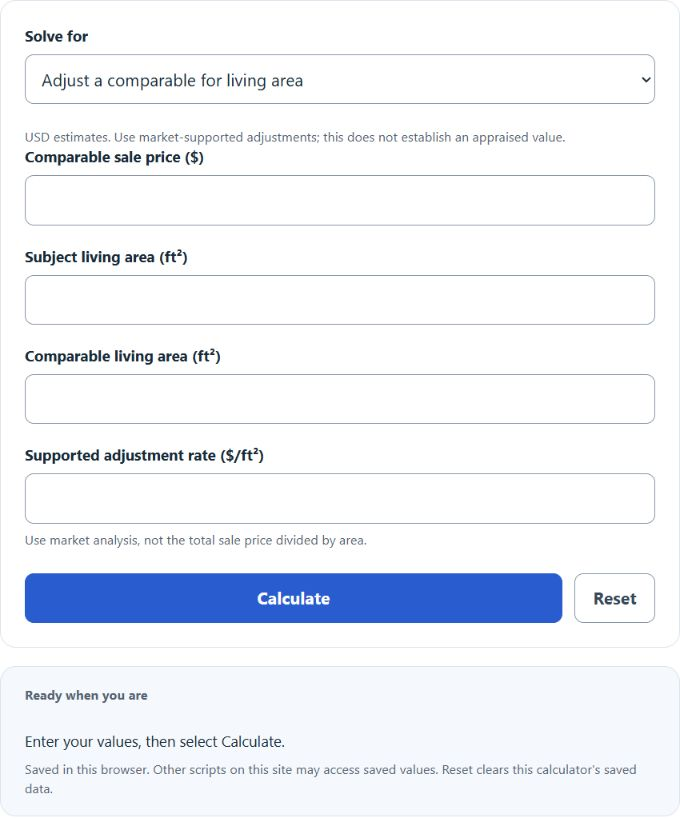
Calculate market-supported GLA or total comparable-sale adjustments, adjusted value, direction, and net and gross adjustment percentages.
- Cost Per Square Foot Calculator
- Rent To Value Calculator
- All Personal Finance Calculators
- Appraisal Hike Percentage Calculator
Appraisal Adjustment Formula
The paired-sales mode calculates the factor below. The GLA mode applies a supported rate: adjustment = (subject area − comparable area) × rate. The totals mode combines positive and negative adjustments. Amounts are in USD and areas in square feet.
- Where AF is the appraisal adjustment factor ($/ft²)
- P1 is the sale price of property 1 ($)
- P2 is the sale price of property 2 ($)
- A1 is the gross living area of property 1 (ft²)
- A2 is the gross living area of property 2 (ft²)
What Is an Appraisal Adjustment Factor?
An appraisal adjustment factor is a dollar-per-square-foot rate that quantifies how much the market pays for each additional unit of living area between two otherwise comparable properties. It is the core output of a matched pair analysis and is applied directly in the Sales Comparison Approach to value real property. Rather than using a blanket price-per-square-foot figure derived from the whole sale price, the adjustment factor isolates only the contribution of size to value, holding all other variables constant.
The factor is market-specific and time-specific. A $60/ft² size adjustment in a high-demand urban suburb may be entirely appropriate, while the same figure would be unsupportable in a rural market where homes trade at $80/ft² total. Appraisers are required to derive the factor from local sales data rather than applying a regional average or rule of thumb.
Matched Pair Analysis: How the Factor Is Extracted
The standard method for deriving an adjustment factor is matched pair analysis (also called paired sales analysis). The appraiser identifies two sales that are as identical as possible in location, condition, age, and quality, differing meaningfully in only one variable: gross living area (GLA). The price difference between those two sales is then divided by the GLA difference to produce the adjustment factor.
A single pair can be distorted by other differences. Review multiple relevant sales and supporting market analysis before adopting a factor; a close numerical fit alone does not establish comparability.
The factor derived from matched pairs is then applied to the GLA difference between the subject property and each comparable: if a comparable is 200 ft² smaller than the subject and the derived factor is $55/ft², the appraiser adds $11,000 to that comparable's sale price before reconciling values.
The Four Categories of Appraisal Adjustments
The GLA adjustment factor this calculator produces is one component of a broader adjustment grid used in the Sales Comparison Approach. Appraisers apply adjustments in a defined sequence, and the order matters because some adjustments change the baseline from which subsequent ones are calculated.
Transactional adjustments address financing and sale conditions. Seller-paid concessions are adjusted for their supported effect on price; a $15,000 concession does not automatically justify a $15,000 deduction.
Market conditions adjustments (time adjustments) account for appreciation or depreciation between the date of the comparable sale and the effective date of the appraisal. In a market appreciating at 6% annually, a comparable that sold 12 months ago would receive a roughly 6% upward adjustment before any other differences are addressed. The Federal Housing Finance Agency has documented that time adjustments are systematically underused in residential appraisals, which can bias value estimates downward in rising markets.
Location adjustments address differences in neighborhood desirability, school district quality, proximity to employment centers, or street-level factors such as traffic or backing to a highway. Two properties one block apart in different school attendance zones can warrant a location adjustment of 5% to 15% or more in highly competitive markets.
Physical adjustments cover all property-specific features: GLA, bedroom and bathroom count, garage stalls, lot size, condition, quality, basement finish, pools, decks, and functional obsolescence. GLA is typically the largest single physical adjustment line item, which is why deriving a well-supported $/ft² factor is critical to appraisal accuracy. According to CoreLogic data, adjustments are made in 99.8% of all residential appraisals, with GLA, room count, and garage among the most frequent adjustment categories.
Why GLA Adjustments Are Smaller Than a Simple Price-Per-Square-Foot Analysis Suggests
A common point of confusion arises when homeowners or agents compare an appraiser's GLA adjustment to a simple price-per-square-foot calculation. A home selling at $400,000 with 2,000 ft² implies a total price of $200/ft². A homeowner might expect that a 200 ft² difference between two homes would therefore produce a $40,000 adjustment. In practice, the appraiser's size adjustment is almost always a fraction of that figure, often $25 to $75 per square foot even in markets with total values well above $200/ft².
The reason is that the total sale price includes the lot, landscaping, garage, pool, and every other feature of the property. When an appraiser isolates the GLA adjustment, those other features are already being adjusted for in separate lines of the grid. Applying the full market price per square foot to a size difference would double-count the value of every non-GLA feature that correlates with size. The GLA adjustment reflects only the incremental value the market places on living area itself, stripped of everything else.
Diminishing returns compound this effect. Markets tend to pay progressively less per additional square foot as homes grow larger. The difference between a 1,200 ft² and a 1,400 ft² home typically commands a higher per-foot premium than the difference between a 3,000 ft² and a 3,200 ft² home. This means the adjustment factor derived from matched pairs in one size tier should not be applied mechanically to properties in a different size tier without verification.
Adjustment Guidelines and Lending Standards
Fannie Mae does not specify net or gross adjustment limits. Adjustments must reflect market evidence, and extensive adjustments require adequate explanation and support. See Fannie Mae’s current adjustment guidance.
FHA program requirements and lender overlays must be checked for the assignment. Disproportionate adjustments require explanation and reexamination; this calculator does not apply universal 10%, 15%, or 25% approval thresholds.
A defensible factor needs relevant market evidence for the property, location and effective date. Paired sales are one method; other supported analyses may be appropriate. A factor from a different market or size range should not be applied without verification.