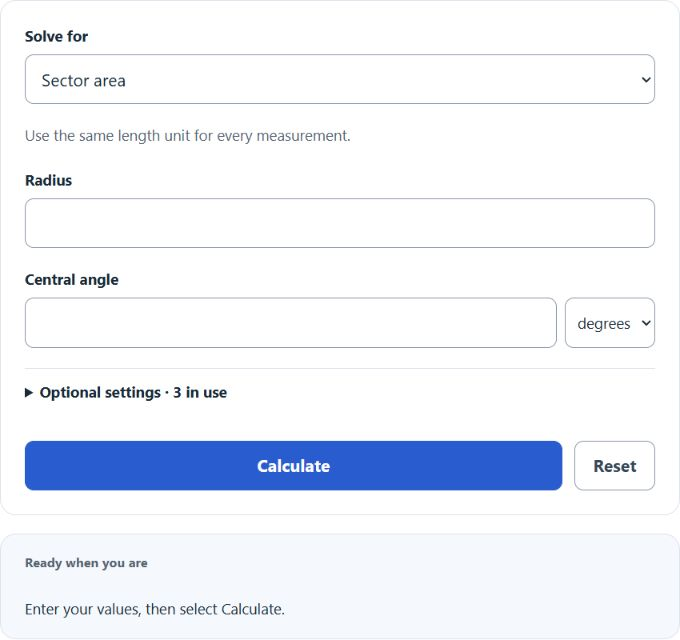
Calculate the area of a sector from a radius and central angle, or solve for the radius, angle, arc length, or annulus sector area.
- All Math & Numbers Calculators
- Central Limit Theorem Calculator
- Area Of A Triangle Without Height Calculator
Area of a Sector Formula
A sector is the pie-shaped region bounded by two radii and the arc between them. The formula you use depends on whether the central angle is measured in degrees or radians, and on which value you are solving for.
Sector area from a radius and an angle in degrees:
A = (theta / 360) * pi * r^2
Sector area when the angle is in radians:
A = (1/2) * r^2 * theta (full-precision pi)
Solving for the radius from a known area and angle in degrees:
r = sqrt( (360 * A) / (pi * theta) )
Solving for the central angle in degrees from a known area and radius:
theta = (360 * A) / (pi * r^2)
Arc length and the full sector perimeter:
L = (theta / 360) * 2 * pi * r
P = L + 2 * r for angles below 360 degrees; P = L for a full circle.
Annulus sector area (a ring segment between an outer radius R and an inner radius r):
A = (theta / 360) * pi * (R^2 - r^2)
- A = area of the sector (square units)
- r = radius of the circle, or the inner radius for an annulus sector
- R = outer radius for an annulus sector
- theta = central angle of the sector (degrees or radians)
- L = arc length along the curved edge
- P = perimeter, the arc length plus two radii for a partial sector; the circumference for a full circle
- pi = the constant 3.14159..., or 3.14 if you choose the rounded value
Each solve mode rearranges the same core relationship: a sector covers the fraction theta/360 of a full circle when the angle is in degrees, or theta/(2*pi) when it is in radians. The arc length uses the same fraction applied to the full circumference, and the annulus mode subtracts the inner sector area from the outer one before scaling by the angle.
Common Central Angles and Their Sector Fractions
The table below shows how much of a full circle a sector covers for several common central angles. Multiply the fraction by pi*r^2 to get the sector area.
| Central angle | In radians | Fraction of circle | Area as a multiple of r^2 |
|---|---|---|---|
| 30 degrees | pi/6 | 1/12 | 0.2618 r^2 |
| 45 degrees | pi/4 | 1/8 | 0.3927 r^2 |
| 60 degrees | pi/3 | 1/6 | 0.5236 r^2 |
| 90 degrees | pi/2 | 1/4 | 0.7854 r^2 |
| 180 degrees | pi | 1/2 | 1.5708 r^2 |
| 360 degrees | 2*pi | 1 (full circle) | 3.1416 r^2 |
To read the last column, take the multiplier and apply it to your radius squared. A 90 degree sector of a circle with radius 4 has an area of 0.7854 * 4^2 = 12.57 square units.
Example Problems
Example 1. Find the area of a sector with a radius of 6 inches and a central angle of 120 degrees.
Apply the degree formula: A = (120 / 360) * pi * 6^2 = (1/3) * pi * 36 = 12 * pi, which is about 37.70 square inches.
Example 2. A sector has an area of 50 square centimeters and a central angle of 90 degrees. Find the radius.
Use the radius formula: r = sqrt( (360 * 50) / (pi * 90) ) = sqrt( 18000 / 282.74 ) = sqrt(63.66), which is about 7.98 centimeters.
FAQ
What is the difference between using degrees and radians?
Both describe the same angle; only the unit changes. In degrees a full circle is 360 and the sector covers theta/360 of it, so the area is (theta/360)*pi*r^2. In radians a full circle is 2*pi and the formula simplifies to (1/2)*r^2*theta. Pick the unit that matches the angle you were given and the calculator handles the conversion.
How is a sector different from a segment?
A sector is bounded by two radii and the arc between them, so it looks like a slice of pie. A segment is bounded by a chord and the arc, so it is the region you get after cutting straight across. The primary formulas on this page are for sectors. Segment area is also shown in Calculation details.
What is an annulus sector?
An annulus sector is a slice taken out of a ring rather than a full disk. It has an outer radius R and an inner radius r, and you find its area by subtracting the inner sector from the outer one: (theta/360)*pi*(R^2 - r^2). This is useful for shapes like washers, curved paths, or arched window frames.