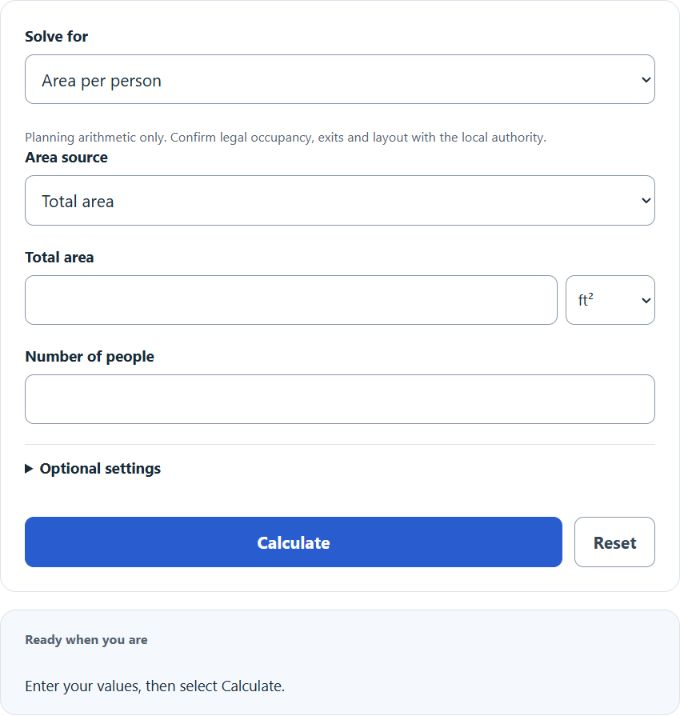
Calculate area per person, maximum whole-person capacity, or total space needed from room area or dimensions in square feet, square meters, and square yards.
Related Calculators
- Dehumidifier Capacity Calculator
- Rug Size Calculator
- Picture Spacing Calculator
- Heating Oil Usage Calculator
- All Everyday Life and Education Calculators
Area Per Person Formula
The calculator uses three formulas, one for each mode.
Area per person:
Room capacity:
Space needed:
- A_p = area allotted per person (sq ft)
- A_total = total room or floor area (sq ft)
- A_unavailable = area taken by stage, dance floor, fixtures, storage (sq ft)
- A_extra = fixed extras like buffet, kitchen, or AV space (sq ft)
- N = number of people
- N_max = maximum number of people the usable area can hold
Assumptions: the area is flat, rectangular or already measured, and the per-person figure already accounts for circulation in dense layouts. If you enter length and width, the calculator multiplies them and converts to square feet internally before applying the formula. Mixed input units are accepted; everything is converted to sq ft for the math and back to your chosen unit for the result.
Choose Area per person to divide usable area by headcount. Maximum whole people divides usable area by your entered allocation and rounds down. Total area needed multiplies headcount by your allocation and adds optional fixed extras. No layout density is selected automatically.
Typical Density and Capacity Values
These are illustrative area assumptions for comparing scenarios, not validated recommendations or building-code factors. Enter the allocation appropriate to your project. They do not determine permitted occupancy, safety or comfort.
| Setup | Sq ft / person | Sq m / person |
|---|---|---|
| Standing reception | 6 | 0.56 |
| Theater seating | 8 | 0.74 |
| Banquet or dining | 15 | 1.39 |
| Classroom | 20 | 1.86 |
| Conference room | 30 | 2.79 |
| Retail floor | 30 | 2.79 |
| Trade show booths | 100 | 9.29 |
| Open office, efficient | 120 | 11.15 |
| Open office, average | 220 | 20.44 |
| Office, spacious | 320 | 29.73 |
No universal area-per-person threshold determines comfort or safe occupancy.
Worked Examples and FAQ
Example 1: Office check. You have a 4,800 sq ft office with 30 employees. A_p = 4,800 / 30 = 160 sq ft per person. That is the arithmetic allocation; comfort depends on the actual layout and use.
Example 2: Wedding venue. Your hall is 60 ft by 50 ft, which is 3,000 sq ft. A 400 sq ft dance floor is unavailable for seating. Usable area is 2,600 sq ft. At 15 sq ft per person for banquet seating, capacity is floor(2,600 / 15) = 173 guests.
Example 3: Conference planning. You expect 200 attendees for a theater-style keynote and need 500 sq ft for the stage. Required area = 200 × 8 + 500 = 2,100 sq ft.
Does this match fire code occupancy? No. Occupant-load rules depend on the function of the space, net or gross area, fixed seating and egress requirements. Confirm permitted occupancy with your local authority; area division alone does not establish it.
Should I include hallways, restrooms, and back of house? No. Use only the area people will actually occupy. Subtract fixed obstructions in the unavailable area field.
Why does the capacity result round down? You cannot fit a fraction of a person, and rounding up would push the room past its intended density.
Can I mix units? Yes. Enter the room in meters and extras in square feet if that is how you have the data. The calculator converts everything before computing.