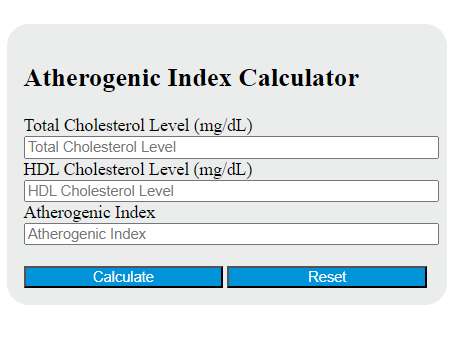
Use the calculator below to estimate a cholesterol-based atherogenic index (often called the atherogenic coefficient, calculated from total cholesterol and HDL) or the Atherogenic Index of Plasma (AIP) (calculated as log10(TG/HDL) using fasting triglycerides and HDL). This calculator can also solve for any one variable when the other two are known.
Atherogenic Index Formulas
This calculator includes two distinct lipid ratios, each derived from a different pair of blood lipid values.
Cholesterol-based Atherogenic Index (Atherogenic Coefficient)
AC = (TC - HDL) / HDL
Where TC is total cholesterol and HDL is high-density lipoprotein cholesterol, both in matching units (mg/dL or mmol/L). The numerator (TC minus HDL) equals non-HDL cholesterol, which includes LDL, VLDL, IDL, and lipoprotein(a). This ratio captures the balance between cholesterol delivery into artery walls by atherogenic lipoproteins and cholesterol removal by HDL-mediated reverse transport back to the liver. An AC below 3.0 is generally considered low risk.
Atherogenic Index of Plasma (AIP)
AIP = log_{10}(TG / HDL)Where TG is fasting triglycerides and HDL is HDL cholesterol, both in mmol/L. If values are in mg/dL, convert TG by dividing by 88.57 and HDL by dividing by 38.67 before applying the formula. The logarithmic transformation normalizes the skewed distribution of the TG/HDL ratio across populations. AIP was first proposed by Dobiasova and Frohlich as a biomarker that reflects the true relationship between protective and atherogenic lipoprotein fractions more accurately than either lipid value alone.
AIP Risk Stratification
Two risk stratification frameworks appear in the clinical literature. The conservative thresholds classify AIP below 0.11 as low cardiovascular risk, 0.11 to 0.21 as intermediate risk, and above 0.21 as high risk. A population-based framework sets the boundaries slightly differently: below 0.1 is low risk, 0.1 to 0.24 is medium risk, and above 0.24 is high risk.
For population context, umbilical cord blood and young children typically show AIP values below 0.1. Healthy adult women generally remain near or below 0.1, while adult men average somewhat higher. Individuals with established cardiovascular risk factors such as hypertension, type 2 diabetes, or dyslipidemia commonly have AIP values ranging from 0.2 up to 0.4 or beyond.
Why AIP Reflects LDL Particle Size
The primary reason AIP outperforms individual lipid measurements as a cardiovascular predictor is its strong inverse correlation with LDL particle size (r = -0.776 in validation studies). When triglycerides are elevated and HDL is low, hepatic lipase activity increases, stripping lipid from LDL particles and producing small, dense LDL (sdLDL, pattern B). These smaller particles penetrate the arterial endothelium more easily, bind more readily to arterial wall proteoglycans, and are more susceptible to oxidation, all of which accelerate plaque formation.
A standard lipid panel reports total LDL cholesterol but does not distinguish between large buoyant LDL (pattern A, lower risk) and small dense LDL (pattern B, higher risk). Two patients with identical LDL-C levels can have dramatically different cardiovascular risk profiles depending on their particle size distribution. AIP serves as an accessible proxy for this particle size information without requiring advanced lipoprotein testing such as NMR spectroscopy or ion mobility analysis.
Clinical Applications Beyond Coronary Artery Disease
While AIP was originally developed as a cardiovascular risk marker, research over the past decade has established its predictive value across several metabolic conditions.
Metabolic Syndrome: A meta-analysis found that AIP has a diagnostic AUC of 0.864 for metabolic syndrome detection. AIP levels are significantly elevated in metabolic syndrome patients compared to healthy individuals, and the index may serve as a practical screening tool given that it requires only two routine lab values.
Non-Alcoholic Fatty Liver Disease (NAFLD): AIP is an independent predictor of metabolic-associated fatty liver disease in patients with type 2 diabetes, with predictive accuracy exceeding 70%. AIP has demonstrated better predictive value than traditional liver markers (AST, ALT, ALP) and BMI for identifying NAFLD in diabetic populations.
Type 2 Diabetes: A 9-year longitudinal study found that elevated AIP independently predicts incident type 2 diabetes, hypertension, and metabolic syndrome. In patients with existing NAFLD, elevated AIP is independently associated with increased risk of developing type 2 diabetes.
Chronic Kidney Disease: Emerging research identifies AIP as an early marker for chronic kidney disease progression in patients with type 2 diabetes, potentially allowing earlier intervention than traditional renal function markers alone.
AIP vs. Other Lipid Ratios
Several lipid ratios are used in cardiovascular risk assessment. Castelli's Risk Index I (CRI-I) is TC/HDL-C, with values above 5.0 in men or 4.5 in women indicating elevated risk. Castelli's Risk Index II (CRI-II) uses LDL-C/HDL-C, with values above 3.5 in men or 3.0 in women considered high risk. The atherogenic coefficient (AC) uses (TC minus HDL-C)/HDL-C.
Comparative studies have found that AIP is the most sensitive marker among these four indices for predicting cardiovascular events. Its advantage stems from the logarithmic transformation and the use of triglycerides rather than total or LDL cholesterol. Since triglyceride levels directly reflect VLDL metabolism and are mechanistically linked to the generation of small dense LDL particles, AIP captures a dimension of dyslipidemia that pure cholesterol ratios miss.
Unit Conversions for AIP Calculation
AIP must be calculated using molar concentrations (mmol/L). Most U.S. laboratories report lipids in mg/dL. To convert triglycerides from mg/dL to mmol/L, divide by 88.57. To convert HDL cholesterol from mg/dL to mmol/L, divide by 38.67. The calculator above performs these conversions automatically when mg/dL is selected.
Factors That Influence Your Atherogenic Index
Diet composition directly affects both AIP components. Refined carbohydrates and excess fructose drive hepatic triglyceride synthesis. Trans fats simultaneously raise triglycerides and lower HDL. Omega-3 fatty acids from fish oil lower triglycerides by 15 to 30% depending on dose. Regular aerobic exercise raises HDL by approximately 5 to 10% and lowers triglycerides by 10 to 20%, improving AIP through both components simultaneously.
Alcohol intake has a nonlinear relationship with AIP. Moderate consumption tends to raise HDL, improving the index. Heavy consumption raises triglycerides substantially. Smoking lowers HDL and shifts LDL toward smaller, denser particles. Insulin resistance is the most common metabolic driver of elevated AIP, as it increases hepatic VLDL output while simultaneously impairing HDL metabolism.
Certain medications also alter AIP. Statins primarily lower LDL-C and have modest effects on AIP. Fibrates lower triglycerides substantially and are more effective at reducing AIP directly. Niacin raises HDL and lowers triglycerides, producing the largest AIP improvements among lipid-lowering drugs. SGLT2 inhibitors and GLP-1 receptor agonists used in diabetes management have shown favorable effects on AIP as a secondary benefit.