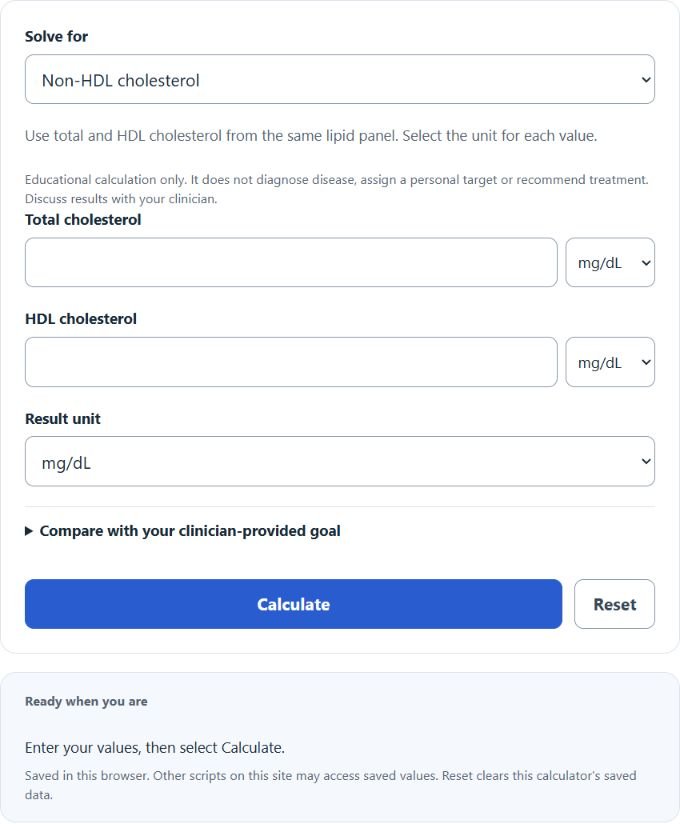
Calculate non-HDL cholesterol from total and HDL cholesterol, solve for a missing value, and convert results between mg/dL and mmol/L.
Non-HDL Cholesterol Formula
Non-HDL cholesterol is the portion of your total cholesterol carried by all lipoproteins other than HDL. It is commonly used as a practical marker of atherogenic cholesterol because it captures more than LDL alone.
- Non-HDL
- Non-HDL cholesterol
- TC
- Total cholesterol
- HDL
- High-density lipoprotein cholesterol
Important: select the correct unit for each input and use values from the same lipid panel. The calculator converts mg/dL and mmol/L to a common basis before the arithmetic. Choose the result unit separately; the alternate unit is also shown.
Reverse Formulas
This calculator can also solve for a missing total cholesterol or HDL value when the other two values are known.
What Non-HDL Cholesterol Includes
Non-HDL cholesterol represents the cholesterol carried in the lipoproteins most associated with plaque formation in arteries. That includes:
- LDL cholesterol
- VLDL cholesterol
- IDL cholesterol
- Remnant lipoproteins
- Other atherogenic particles outside HDL
Because it includes more than LDL, non-HDL cholesterol is often used as a broader snapshot of cholesterol-related cardiovascular risk, especially when triglycerides are elevated.
How to Calculate Non-HDL Cholesterol
- Find your total cholesterol value on a lipid panel.
- Find your HDL cholesterol value.
- Subtract HDL from total cholesterol.
- The result is your non-HDL cholesterol.
If your lab report already lists non-HDL cholesterol, this calculator is useful for verifying the number or solving for a missing value.
Examples
If total cholesterol is 200 mg/dL and HDL is 50 mg/dL:
If total cholesterol is 5.20 mmol/L and HDL is 1.30 mmol/L:
Risk-Specific Interpretation Guide
| Clinical context | Adult goal or pediatric reference | Approx. mmol/L |
|---|---|---|
| Borderline/intermediate-risk adult primary prevention when statin therapy is initiated | Below 130 mg/dL | Below 3.36 mmol/L |
| High-risk adult primary prevention when statin therapy is initiated; clinical ASCVD not at very high risk | Below 100 mg/dL | Below 2.59 mmol/L |
| Very-high-risk ASCVD | Below 85 mg/dL | Below 2.20 mmol/L |
| Children and adolescents: NHLBI acceptable category | Below 120 mg/dL | Below 3.10 mmol/L |
Adult treatment goals depend on the complete clinical assessment; the pediatric row is a reference category rather than an individually prescribed treatment goal. A clinician should assign any applicable goal. Some adults with ASCVD who are not at very high risk may also be assigned a stricter goal. The calculator does not assign a risk category or treatment target.
A common clinical rule of thumb is that the non-HDL goal is about 30 mg/dL higher than the LDL goal.
- If an LDL goal is 100 mg/dL, the non-HDL goal is often about 130 mg/dL.
- If an LDL goal is 70 mg/dL, the non-HDL goal is often about 100 mg/dL.
Interpretation should always be individualized. A value that may be acceptable for one person may be too high for someone with diabetes, kidney disease, established cardiovascular disease, or multiple risk factors.
Unit Conversion
If you need to convert between the two common cholesterol units, use the following relationships. Convert values to a common unit before subtracting; this calculator does that from each field’s selected unit. It uses 0.02586 in both directions rather than treating the rounded reciprocal 38.67 as an exact constant.
Why This Number Is Useful
- It is easy to calculate from a standard lipid panel.
- It reflects more atherogenic cholesterol than LDL alone.
- It is often helpful when triglycerides are high.
- It provides a quick cross-check against the non-HDL value listed on a lab report.
Common Reasons Non-HDL Cholesterol Is High
- Diet high in saturated or trans fats
- Excess body weight
- Low physical activity
- Smoking
- Diabetes or insulin resistance
- Hypothyroidism
- Kidney disease
- Inherited lipid disorders
- Certain medications
Ways to Improve a High Non-HDL Result
- Reduce saturated fat and eliminate trans fat where possible.
- Emphasize vegetables, fruit, legumes, oats, nuts, and other high-fiber foods.
- Choose lean proteins and more unsaturated fats in place of fatty processed foods.
- Exercise consistently and maintain a healthy weight.
- Stop smoking and limit excess alcohol intake.
- Manage contributing conditions such as diabetes or thyroid disease.
- Discuss medication options with a healthcare professional when lifestyle measures are not enough.
Practical Notes
- Non-HDL cholesterol is not the same as LDL cholesterol.
- Non-HDL is usually higher than LDL because it includes LDL plus other non-HDL fractions.
- A normal result does not replace full cardiovascular risk assessment.
- Small differences between your calculation and a lab report can happen because of rounding.
This calculator is best used as an educational tool and quick reference for understanding lipid panel results. Its optional goal comparison uses only a goal you enter from your clinician or laboratory and does not determine whether treatment is needed.
Sources
2026 ACC/AHA multisociety dyslipidemia guideline; ACC explanation of risk-based adult goals; NHLBI pediatric guidance, Table 9–1 and non-HDL formula; CDC NHANES cholesterol unit conversion.