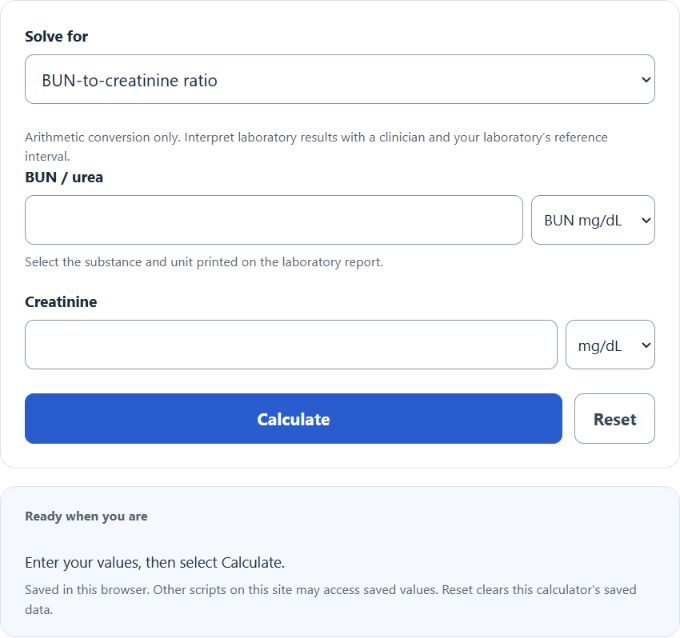
Calculate or reverse-solve the BUN-to-creatinine ratio with transparent urea and creatinine SI conversions, normalized values, and laboratory-context wording.
- All Ratio Calculators
- Cholesterol Ratio Calculator
- All Health and Medical Calculators
- Recombination Frequency Calculator
- Urine K To Creatinine Ratio Calculator
BUN Creatinine Ratio Formula
- BUN = blood urea nitrogen, in mg/dL
- Creatinine = serum creatinine, in mg/dL
If your lab reports urea instead of BUN, convert first: BUN (mg/dL) = urea (mmol/L) × 2.801, or BUN (mg/dL) = urea (mg/dL) × 0.467. For creatinine in µmol/L, divide by 88.4 to get mg/dL. The ratio itself is unitless because both values are expressed in mg/dL.
Rearranged forms used by the calculator:
Reference Ranges and Interpretation
Adult reference intervals vary by laboratory. The bands below are descriptive examples, not diagnostic targets; the calculator reports arithmetic results without assigning a category.
| Ratio | Category | Common considerations |
|---|---|---|
| < 10:1 | Low | Low protein intake, liver disease, SIADH, rhabdomyolysis, pregnancy |
| 10:1 to 20:1 | Typical | Within usual adult range |
| > 20:1 | High | Dehydration, prerenal azotemia, GI bleed, high-protein intake, catabolic state |
Typical lab reference values for the inputs:
| Marker | Adult male | Adult female |
|---|---|---|
| BUN | 8 to 24 mg/dL | 6 to 21 mg/dL |
| Creatinine | 0.74 to 1.35 mg/dL | 0.59 to 1.04 mg/dL |
| Urea (SI units) | 2.9 to 8.6 mmol/L | 2.1 to 7.5 mmol/L |
Worked Example
A patient has BUN of 28 mg/dL and creatinine of 1.4 mg/dL.
Ratio = 28 / 1.4 = 20:1. If BUN is 42 mg/dL and creatinine remains 1.4 mg/dL, the ratio is 30:1. These arithmetic results alone do not establish the cause or distinguish dehydration from kidney disease; a clinician must consider other tests and the full clinical context.
FAQ
Is BUN the same as urea? No. BUN measures only the nitrogen portion of urea. Urea is roughly 2.14 times the BUN value when both are in the same mass units.
Why must both values be in mg/dL? The ratio cancels units only when numerator and denominator share them. Mixing mg/dL with µmol/L gives a meaningless number.
Does the ratio replace eGFR? No. The ratio is one part of a clinical assessment and cannot establish the cause of an abnormal result. eGFR estimates kidney function; interpretation also depends on other tests and clinical context.