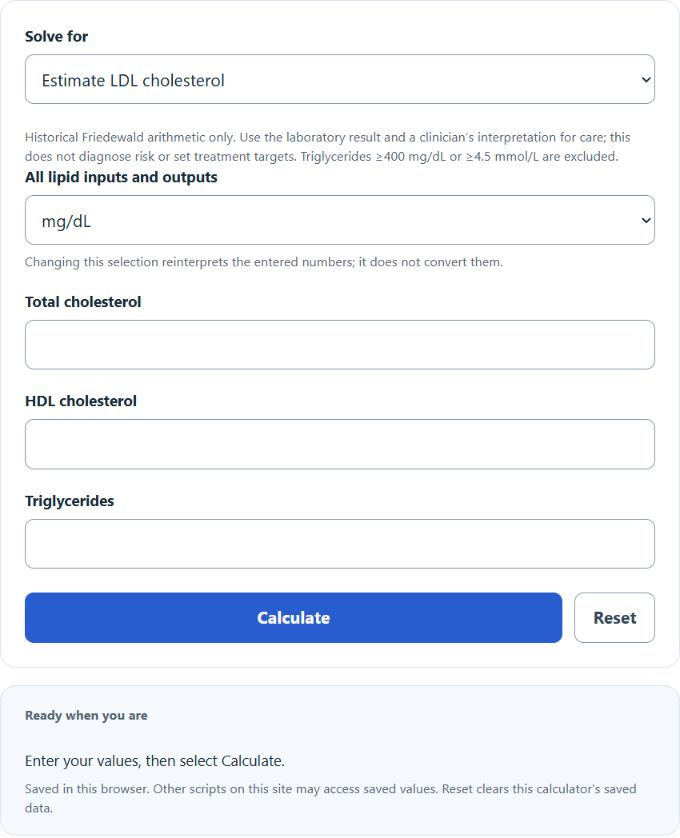
Calculate estimated LDL cholesterol or solve for total cholesterol, HDL, or triglycerides from any three lipid-panel values in mg/dL or mmol/L, with common ratios.
Estimated LDL Cholesterol Friedewald Formula
The Friedewald equation estimates LDL cholesterol from total cholesterol, HDL cholesterol, and triglycerides. Select mg/dL or mmol/L for all entered values. The conventional triglyceride divisor is 5 in mg/dL and 2.2 in mmol/L; these rounded conventions do not give exactly identical results after unit conversion.
- LDL = estimated low-density lipoprotein cholesterol, in mg/dL
- TC = total cholesterol, in mg/dL
- HDL = high-density lipoprotein cholesterol, in mg/dL
- TG = triglycerides, in mg/dL
Choose the value to solve for, then enter the three visible lipid values. LDL is an estimate; rearranging the equation for another lipid gives an algebraic consistency result, not a substitute for measuring that lipid:
- Calculate LDL: enter total cholesterol, HDL, and triglycerides.
- Calculate total cholesterol: enter LDL, HDL, and triglycerides.
- Calculate HDL: enter total cholesterol, LDL, and triglycerides.
- Calculate triglycerides: enter total cholesterol, HDL, and LDL.
Current LDL-C Interpretation Context
LDL-C goals are risk-specific and should be assigned from the complete clinical assessment. The former optimal, near-optimal, borderline-high, high, and very-high table was removed because it is not a one-size-fits-all 2026 treatment guide. This page demonstrates historical Friedewald arithmetic; the 2026 ACC/AHA guideline prefers Martin/Hopkins or Sampson/NIH estimation, especially with elevated triglycerides or low LDL/non-HDL. The EAS/EFLM consensus describes the historical formula and its assumptions.
When the Friedewald Estimate Is Less Reliable
| Situation | Why it matters |
|---|---|
| Triglycerides are ≥400 mg/dL or ≥4.5 mmol/L (rounded unit-specific boundaries) | The Friedewald equation is generally not considered valid at this level. |
| Very low LDL values | The estimate may be less accurate, especially when triglycerides are elevated. |
| Non-fasting sample | Nonfasting panels are acceptable for most people. Selective fasting assessment may be needed, especially with elevated triglycerides; follow the laboratory and clinician’s instructions. |
| Unusual lipid patterns or certain medical conditions | A direct LDL test or another estimation method may be preferred. |
Example Problems
Example 1: Calculate estimated LDL cholesterol
You have total cholesterol of 210 mg/dL, HDL of 50 mg/dL, and triglycerides of 150 mg/dL.
The estimated LDL cholesterol is 130 mg/dL.
Example 2: Calculate total cholesterol
You have LDL of 120 mg/dL, HDL of 55 mg/dL, and triglycerides of 100 mg/dL.
The calculated total cholesterol is 195 mg/dL.
FAQ
What does the Friedewald LDL calculation estimate?
It estimates LDL cholesterol using total cholesterol, HDL cholesterol, and triglycerides. The triglyceride value is divided by 5 to estimate VLDL cholesterol in mg/dL, then HDL and estimated VLDL are subtracted from total cholesterol.
Can this replace a lab result or medical advice?
No. This is a calculation based on lipid panel values. Your clinician may use additional information, such as age, blood pressure, diabetes status, smoking status, medications, and cardiovascular history, when interpreting LDL cholesterol and setting a treatment goal.
Why does the calculator require exactly three values?
Choose one of the four variables (TC, HDL, TG, or LDL) to solve for and enter the three visible values in the selected unit. The equation then has one unknown. Reverse solutions show historical equation consistency; they do not reconstruct a measured laboratory value. Total/HDL and LDL/HDL ratios are unchanged by consistent cholesterol unit conversion, but TG/HDL differs between mass and molar units.