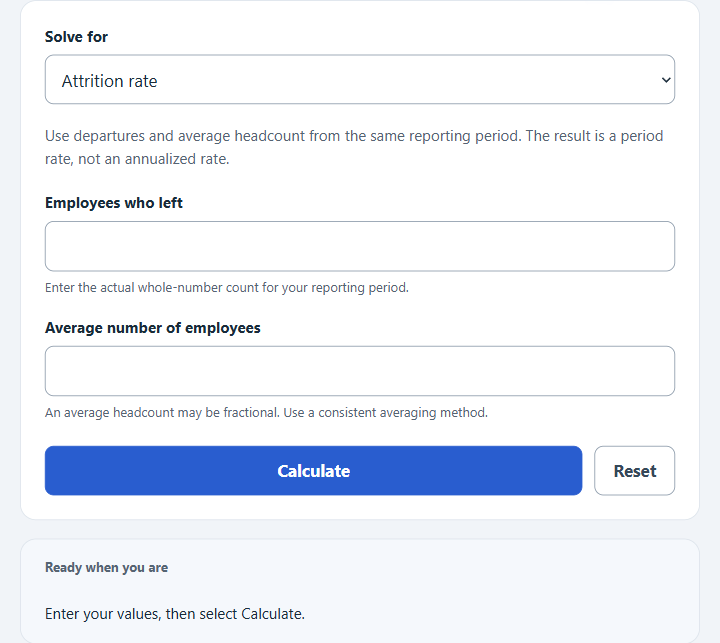
Choose attrition rate, expected departures, or average headcount, then enter the two requested values for the same reporting period.
- All Business Calculators
- Churn Rate Calculator
- Annualized Turnover Calculator
- Employee Stability Index Calculator
- Employment Duration Calculator
- Length of Service Calculator
- Absence Rate Calculator
- Supervisor to Employee Ratio Calculator
Attrition Formula
The following formula can be used to calculate the attrition of a business.
- Where A is the attrition rate (%)
- EL is the total number of employees that have left
- AE is the total average number of employees
To calculate an attrition rate, divide the number of employees that have left by the average number of employees, then multiply by 100.
Attrition Definition
Here, attrition means departures divided by average headcount for the same period. Use a consistent definition of departures; the ratio does not distinguish replaced from unfilled roles. Rates can exceed 100% when repeated hiring and departures occur. Expected departures may be fractional planning estimates, while observed counts are whole people.
Attrition Example
How to calculate attrition?
- First, determine the number of employees that left the company.
Determine the total number of employees that left a company during a certain time period.
- Next, determine the total average number of employees.
Determine the average number of employees during the same time period.
- Finally, calculate the attrition.
Calculate the attrition using the formula above.
FAQ
Attrition is a measure of the rate at which employees leave the employment of a company.