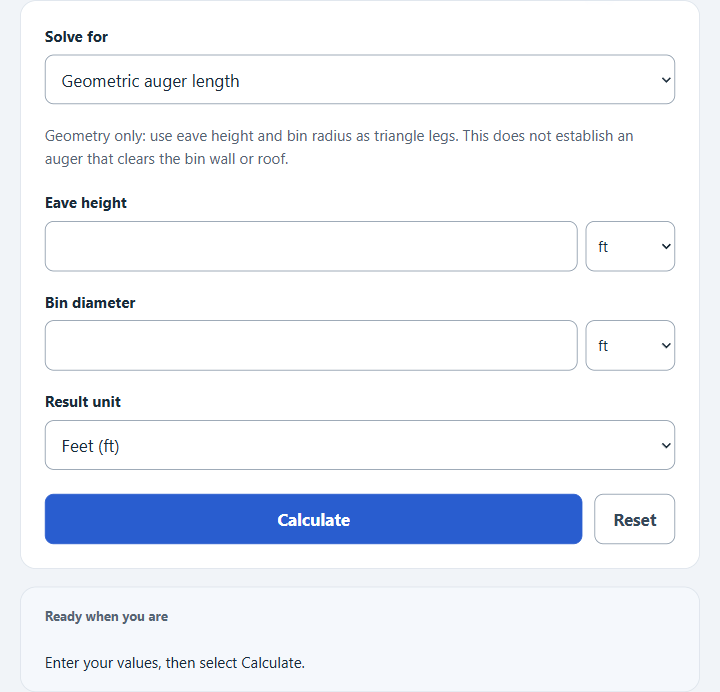
Choose geometric auger length, eave height, or bin diameter, then enter the other two dimensions. This idealized triangle model supports unit conversion but does not establish safe equipment length or clearance.
- All Length Calculators
- Grain Bin Capacity Calculator
- All Construction Calculators
- Bias Tape/Binding Calculator
Auger Length Formula
This simplified calculation treats eave height and half the bin diameter as the legs of a hypothetical right triangle. Its hypotenuse is a geometric length, not a verified auger requirement; the assumed line may intersect the bin wall or roof.
- AL = auger length
- E = eave height of the bin
- D = bin diameter
- D/2 = bin radius, or the horizontal distance from the bin edge to the center
If you need to solve for a different missing value, the same right-triangle relationship can be rearranged.
- To calculate auger length: enter the eave height and bin diameter. The calculator finds the hypotenuse of the idealized triangle.
- To calculate eave height: enter the auger length and bin diameter. The calculator finds the height that satisfies the idealized triangle.
- To calculate bin diameter: enter the auger length and eave height. The calculator finds the bin diameter that matches those dimensions.
Geometric Length Examples for Bin Sizes
The table shows approximate triangle hypotenuses using eave height and bin radius. These values are not equipment sizing recommendations and do not include wall or roof clearance.
| Eave Height | Bin Diameter | Bin Radius | Approx. Geometric Length |
|---|---|---|---|
| 18 ft | 18 ft | 9 ft | 20.12 ft |
| 20 ft | 24 ft | 12 ft | 23.32 ft |
| 24 ft | 30 ft | 15 ft | 28.30 ft |
| 28 ft | 36 ft | 18 ft | 33.29 ft |
| 32 ft | 42 ft | 21 ft | 38.29 ft |
Length Unit Conversions
| Unit | Equivalent in Feet | Example |
|---|---|---|
| Inches | 1 in ≈ 0.083333 ft | 120 in = 10 ft |
| Feet | 1 ft = 1 ft | 25 ft = 25 ft |
| Centimeters | 1 cm ≈ 0.0328084 ft | 300 cm ≈ 9.8425 ft |
| Meters | 1 m ≈ 3.28084 ft | 8 m ≈ 26.2467 ft |
Example Problems
Example 1: Calculate auger length
You have a bin with an eave height of 24 ft and a diameter of 30 ft.
The idealized geometric length is about 28.30 ft.
Example 2: Calculate eave height
You have a 35 ft auger and a bin diameter of 40 ft.
The eave height that matches those values is about 28.72 ft.
FAQ
Why does the formula use half of the bin diameter?
Half the diameter is the bin radius, used here as the horizontal triangle leg. Actual auger placement also requires intake setback, roof height and clearance; bin radius alone does not describe that placement.
Should you round the calculated auger length up?
Rounding this result up is not sufficient to select equipment. Use manufacturer sizing guidance to account for roof rise, intake setback, wall and eave clearance, spout position, operating-angle limits and ground conditions.
Why does the calculator reject some values?
Some combinations are not physically possible. For example, if you enter an auger length that is shorter than the eave height, the auger cannot reach that height. If you solve for eave height, the auger length must also be at least half of the bin diameter.