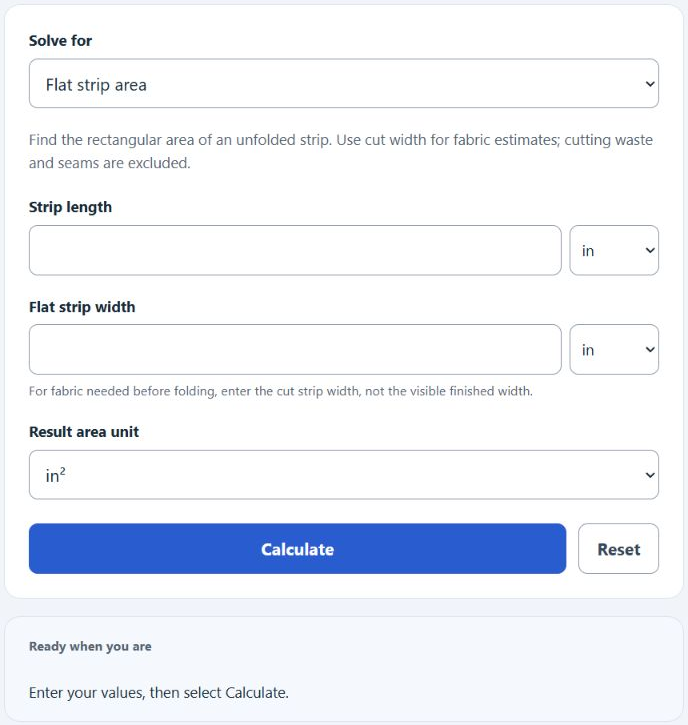
Select flat strip area, length, or width, then enter the two known values. Unit conversions are included; this rectangle model excludes cutting and joining losses.
- Every Day Life And Education Calculators
- Roll Length Calculator
- GSM (Grams per Square Meter) Calculator
- Quilt Backing Calculator
- Fabric Shrinkage Calculator
- Dress Length Calculator
- Grams to Yards Yarn Calculator
Bias Tape/Binding Formula
The calculator treats bias tape or binding as a long rectangle. If you know any two of length, width, and area, it calculates the third value.
- A = bias tape area
- L = bias length
- W = bias width
Calculate area: Enter the bias length and bias width. The calculator multiplies them to find the ideal flat strip area, before cutting and seam allowances.
Calculate length: Enter the bias tape area and bias width. The calculator divides area by width to find the available length.
Calculate width: Enter the bias tape area and bias length. The calculator divides area by length to find the strip width.
The calculator converts all length values to inches and all area values to square inches before calculating, then converts the answer to the result unit you selected.
Common Bias Tape Widths
Use cut strip width to estimate flat fabric area. The illustrative widths below depend on folding method, seam allowance, fabric thickness and pattern; they are not automatic conversions. Check your pattern instructions.
| Common use | Typical finished width | Typical cut strip width |
|---|---|---|
| Narrow garment edges | 1/4 in | 1 in |
| Quilt binding | 1/4 in to 3/8 in | 2 1/4 in to 2 1/2 in |
| Blanket or thick quilt binding | 1/2 in or more | 3 in or more |
Example Calculations
Example 1: Find the bias tape area
You need 120 inches of binding, and the cut strip width is 2.5 inches.
The bias tape area is 300 square inches.
Example 2: Find the bias length
You have 450 square inches of fabric available for bias tape, and your strip width is 2.25 inches.
The theoretical bias length is 200 inches, before cutting, joining and trimming losses.
FAQ
Does this calculate continuous bias binding from a square?
No. This calculator uses the basic area relationship between length, width, and fabric area. It does not account for the special layout used in continuous bias binding, seam allowances, diagonal cutting losses, or trimming waste.
Should you enter cut width or finished width?
Enter the unfolded cut strip width for fabric estimates. A finished folded width measures a different quantity and must not be used to estimate the full fabric requirement. Follow your pattern or tape-maker instructions to determine cut width.
Should you add extra length for seams and corners?
Yes. For sewing projects, add extra length for joining strips, mitered corners, overlap at the ends, and handling waste. A common approach is to calculate the required length first, then add several extra inches before cutting.