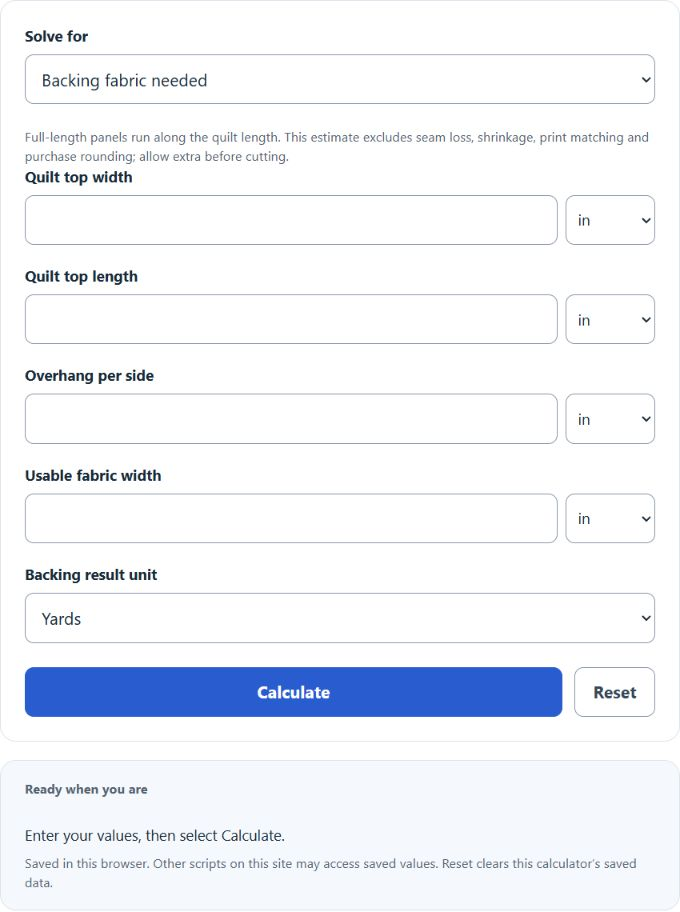
Choose backing fabric needed, quilt length supported, or maximum quilt width supported. Enter the known measurements, overhang per side and usable fabric width. The fixed full-length-panel estimate excludes seam loss, shrinkage, print matching and purchase rounding.
Related Calculators
- Fabric Consumption Calculator
- Fabric Shrinkage Calculator
- Pillow Yardage Calculator
- Bias Tape Binding Calculator
- Fabric Weight Calculator
- Stitches Per Inch Calculator
- All Everyday Life and Education Calculators
Quilt Backing Formula
A quilt backing estimate has two separate goals: determine the finished backing dimensions and determine the fabric yardage required. The backing must be larger than the quilt top so there is enough material for basting, quilting, trimming, and squaring the finished quilt.
If W is the quilt-top width, L is the quilt-top length, and O is the extra backing allowance on each side, the general sizing formulas are:
Here, Bw is the required backing width and Bl is the required backing length. If your process uses a fixed allowance of 2 inches per side, those simplify to:
Once the backing dimensions are known, convert them into yardage based on the usable width of your backing fabric. If the fabric is wide enough to cover the entire backing width in one piece, yardage depends only on the backing length:
If the backing must be pieced from narrower fabric, first calculate the number of panels needed, then convert the total panel length into yards:
In these formulas, F is the usable fabric width in inches, P is the number of backing panels, and Y is the total fabric required in yards before project-specific allowances. Panels run along the quilt length; the calculator does not rotate or optimize them. Seam losses must be allowed for separately. All selected units are converted automatically.
Variable Reference
| Variable | Meaning | Typical Unit |
|---|---|---|
| W | Width of the quilt top | Inches |
| L | Length of the quilt top | Inches |
| O | Extra backing allowance added on each side | Inches |
| Bw | Required backing width after adding allowance | Inches |
| Bl | Required backing length after adding allowance | Inches |
| F | Usable width of the backing fabric | Inches |
| P | Number of fabric panels needed | Panels |
| Y | Total backing fabric to purchase | Yards |
How to Calculate Quilt Backing
- Measure the quilt top width and length using the same unit system.
- Choose how much extra backing you want on every side.
- Calculate the backing width and backing length.
- Check the usable width of the backing fabric, not just the labeled bolt width.
- If the fabric is not wide enough, calculate how many panels must be pieced together.
- Convert the required backing length into yards and round up to a practical purchase amount.
Example
Suppose a quilt top is 60 inches wide and 80 inches long. You want 4 inches of extra backing on each side, and your fabric has 42 inches of usable width.
That means the backing should be at least 68 inches by 88 inches, and a practical purchase amount is 5 yards before adding any extra for seam trimming, print matching, or shrinkage.
Why Backing Yardage Changes So Much
Two quilts with the same top dimensions can require different amounts of backing fabric because yardage depends on more than size alone. The most common differences come from:
- Fabric width: extra-wide backing often needs a single cut, while standard-width fabric usually needs two or more panels.
- Desired overhang: more extra fabric means more room for quilting and trimming.
- Piecing layout: seams, centering, and directional prints can increase the amount you need.
- Rounding: fabric is normally purchased in practical increments, so the final amount is usually rounded up.
Practical Tips Before You Buy Fabric
- Measure the usable width after removing selvages, not just the advertised bolt width.
- Round yardage up rather than buying the exact mathematical minimum.
- If the backing will be quilted by someone else, confirm their minimum extra margin before cutting.
- Directional prints and large repeats often need additional fabric for alignment.
- If you plan to prewash, allow for possible shrinkage before final cutting.
- When piecing panels, include the effect of seam allowances and trimming on the usable finished width.
Common Questions
Is backing the same size as the quilt top?
Not usually. The backing is intentionally larger so the quilt can be basted and quilted without the top shifting beyond the backing edges.
Can I use standard-width fabric for a large quilt?
Yes. In that case, the backing is usually made from two or more panels sewn together. The panel formula above helps estimate how many lengths of fabric are required.
What if I only need the backing dimensions and not the yardage?
Use the backing width and backing length formulas first. Once those dimensions are known, you can stop there or continue to the yardage step if you are buying fabric.
Should I buy the exact yardage shown by the calculator?
It is usually safer to round up. Small allowances for trimming, squaring, seams, and layout flexibility can prevent the backing from ending up too small.