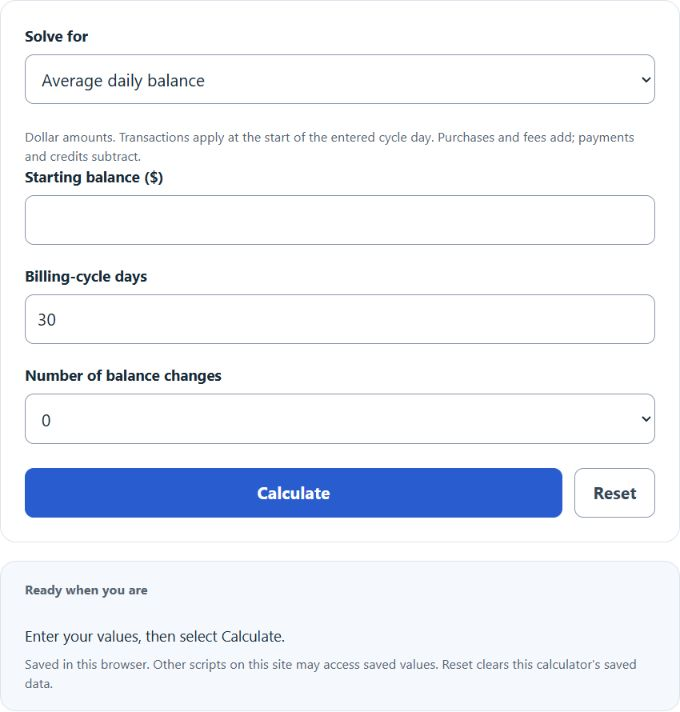
Calculate average daily balance (ADB) from a starting balance and dated deposits, withdrawals, purchases or payments, and estimate card interest from APR.
Average Daily Balance Formula
Variables:
- ADB is the Average Daily Balance ($)
- SDB is the sum of daily balances (dollar-days)
- D is the number of days in the period
To calculate Average Daily Balance, divide the sum of all daily balances by the number of days in the period.
How to Calculate Average Daily Balance?
The following steps outline how to calculate the Average Daily Balance.
- First, determine the sum of daily balances ($).
- Next, determine the number of days in the period.
- Next, gather the formula from above: ADB = SDB / #D.
- Finally, calculate the Average Daily Balance.
- After inserting the variables and calculating the result, check your answer with the calculator above.
Example Problem :
Use the following variables as an example problem to test your knowledge.
sum of daily balances (dollar-days) = 500,000; average = $16,666.67 over 30 days
number of days in the period = 30
How to Combine Monthly Average Daily Balances
Select Combine monthly averages and enter each period’s day count followed by its average daily balance, one period per line. Use non-overlapping periods and the same currency throughout. Use the actual day counts, including 29 for February in a leap year. A month-end balance alone cannot tell you that month’s average daily balance.
Multiply each period’s average daily balance by its day count, add the products, and divide by the total days. The calculator also shows the simple average of the period averages, which gives each period equal weight. For example, enter 28, 1200 and 31, 1800 on separate lines. The daily average across the 59 days is 1,515.25, while the simple average of the two monthly figures is 1,500. A bank that checks a minimum separately each month may use a different rule.
How to Paste Balance Changes From a Spreadsheet
Select Paste transaction changes and enter your starting balance and the number of days in the cycle. Paste two columns without headers: the cycle day (the first day is 1) and the signed amount. Separate them with a tab or comma. Use a positive amount for an increase in the tracked balance and a negative amount for a decrease. Enter only those two values per row. The calculator combines same-day changes, applies them on the posting day, and uses the resulting daily closing balances to calculate the average.
The balance timeline shows the days each closing balance applies to. To estimate simple card interest for that cycle, open Interest estimate and enter an APR and the daily-rate basis from your agreement. The estimate multiplies the nonnegative average daily balance by the daily rate and the cycle length. Actual charges may differ with grace periods, compounding, and multiple rates.
FAQs
What is the purpose of calculating the Average Daily Balance?
The Average Daily Balance is often used by credit card companies to calculate interest charges on a billing statement. It helps in understanding how much interest one might owe based on the daily fluctuation of their account balance.
Can the Average Daily Balance method affect my credit score?
While the Average Daily Balance itself does not directly affect your credit score, the resulting interest charges can influence your credit utilization ratio, which is a key factor in credit scoring models.
How can I lower my Average Daily Balance?
Lowering your Average Daily Balance can be achieved by making payments more frequently throughout the billing cycle, thus reducing the daily balances that are averaged at the end of the period.
Are there any tools available to help calculate the Average Daily Balance?
Yes, there are several online calculators and financial tools available that can help you calculate the Average Daily Balance. Some of these tools also offer insights into how different payment strategies can affect your overall interest charges.
Calculator Change Log:
- Supports a starting balance, up to six balance changes and an estimated cycle-interest mode.