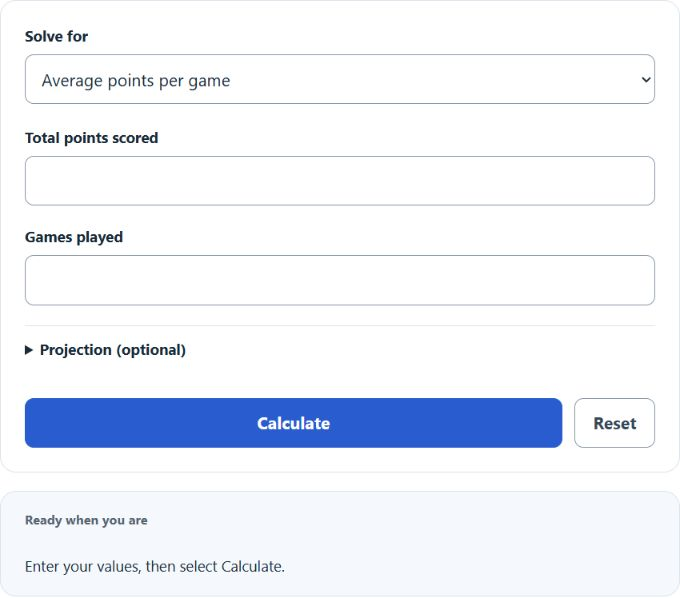
Calculate average points per game (PPG) from total points and games played, project a season total, or find the points needed to reach a target average.
Calculator Functions
| Function | What it does | What it requires |
|---|---|---|
| Average points per game | Finds the scoring average (PPG) of a player or team, and can project it over a season | Requires total points scored and games played |
| Total points | Finds the points scored at a known average over a number of games | Requires the average points per game and games played |
| Equivalent games from points and average | Finds how many games a points total represents at a known average | Requires total points scored and the average points per game |
| Points needed for a target average | Finds the scoring needed in the remaining games to finish at a chosen average | Requires points scored so far, games played so far, the target average and games remaining |
The first function has an optional projection: entering a number of games shows the points total that the same average would produce over that many games. Game counts must be whole numbers. The arithmetic is the same for basketball, football, soccer, hockey or any other sport that counts points or goals.
Average Points Per Game Formulas
| PPG | Average points per game |
| P | Total points scored |
| G | Games played |
Points per game is an arithmetic mean: the sum of the points from every game divided by the number of games. A game with zero points still counts as a game played.
Average points per game
The main formula applies directly. A player with 8,000 points in 200 games averages 8,000 ÷ 200 = 40 PPG. The projection multiplies that average by a game count: 30 points in 3 games is 10 PPG, which comes to 10 × 12 = 120 points over a 12-game season.
Total points
A player who averages 12.5 points over a 24-game season scores 12.5 × 24 = 300 points. A rounded average can give a total with a fraction, while a real total is a whole number.
Equivalent games from points and average
A total of 300 points at 12.5 PPG represents 300 ÷ 12.5 = 24 games. An answer with a fraction means the average was rounded or the two figures do not belong together, because games are whole counts.
Points needed for a target average
N is the additional points needed, T is the target average, G is games played so far, R is games remaining and P is points scored so far. The required average over the remaining games is N ÷ R. A player averaging 23 PPG after 4 games has 92 points. To finish at 25 PPG after one more game the player needs 25 × 5 − 92 = 33 points in that game. When the points already scored cover the target, the answer is 0.
How to Calculate Points Per Game
Add up the points from every game, count the games, and divide the points by the games. Scores of 35, 28, 16, 32 and 18 total 129 points in 5 games, so the average is 129 ÷ 5 = 25.8 PPG. In basketball, total points are 2 for each two-point field goal, 3 for each three-pointer and 1 for each free throw: 53 two-point field goals and 20 free throws over 14 games is 126 points, or 9 PPG.
Limits of This Estimate
- A projection assumes the same average in every future game. It is arithmetic, not a prediction of how a player or team will score.
- The target function assumes every remaining game is played. When points come in whole numbers, a required total with a fraction has to be rounded up.
- An average hides the spread. Two players at 20 PPG can have very different game-to-game scoring, and an average over a few games moves a lot with each new game.