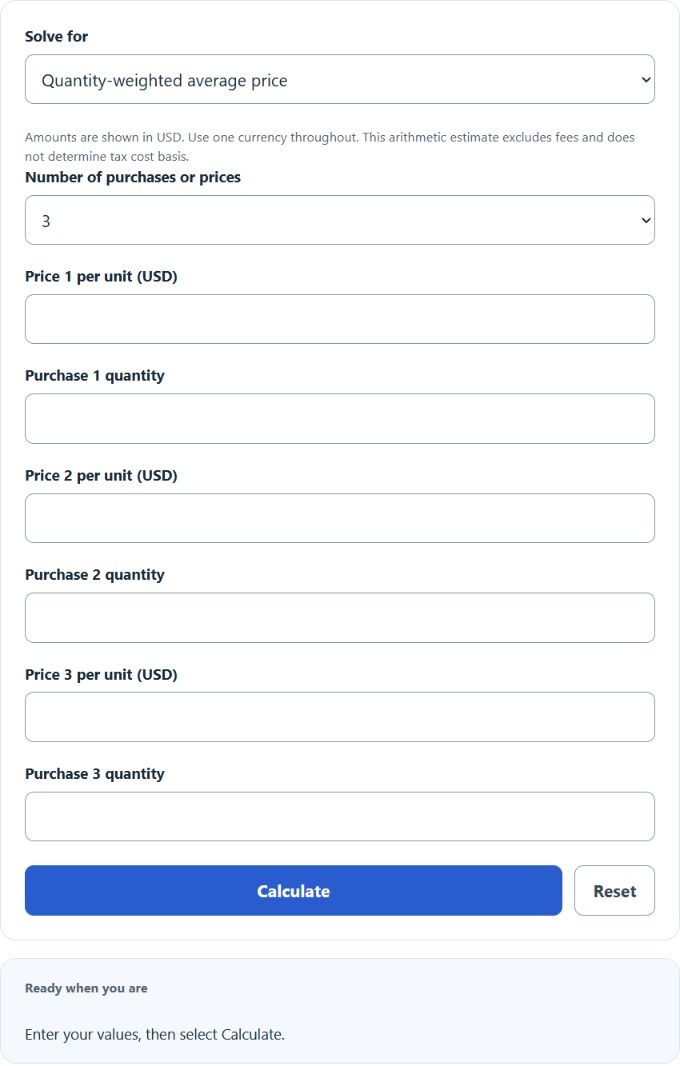
Calculate a quantity-weighted average purchase price or a simple mean from multiple prices, with total cost, units, and high-low price details.
- All Personal Finance Calculators
- All Price Calculators
- Average Cost Calculator
- Average Sales Calculator
- Average Profit Calculator
Average Price Formula
The calculator runs one of two formulas depending on the mode you pick.
Simple average (every price counted equally):
Average = (P1 + P2 + … + Pn) / n
- P1…Pn = each individual price
- n = number of prices entered
Weighted average (each price weighted by quantity, used for dollar-cost averaging or bulk purchases):
Weighted average = Σ(Pi × Qi) / Σ Qi
- Pi = price of purchase i
- Qi = quantity bought at that price
Use the simple formula when each data point represents one unit (a list of grocery prices, quoted rates, daily closing values). Use the weighted formula when quantities differ between purchases — otherwise the simple average will misrepresent your true cost per unit.
Reference Tables
When to pick each mode:
| Use case | Mode |
|---|---|
| Comparing 5 store prices for the same item | Simple |
| Stock or crypto buys at different sizes | Weighted (DCA) |
| Daily closing prices over a week | Simple |
| Inventory bought in different lot sizes | Weighted |
| Quotes from contractors or vendors | Simple |
Worked example showing why the mode matters. Two purchases: 10 units at $5 and 90 units at $10.
| Method | Calculation | Result |
|---|---|---|
| Simple | (5 + 10) / 2 | $7.50 |
| Weighted | (50 + 900) / 100 | $9.50 |
FAQ
What if my list contains a typo or extra text?
Enter one amount in each price field. Plain decimals, unambiguous comma grouping, and an optional leading $ are accepted; extra words and mixed formats are rejected.
How are ties between min and max handled?
The result panel always shows the lowest and highest values, even if they appear more than once.
Does it round?
Ordinary displayed amounts round to two decimal places; very small or large values use scientific notation. Calculations use floating-point arithmetic before display rounding.
Can I use it for cost basis on stocks?
Weighted mode estimates average purchase price per share before fees. It does not select tax lots or determine tax basis; U.S. average-basis eligibility is limited. See the IRS stock-basis guidance.
Why does my weighted average sit closer to one price than the other?
It is pulled toward whichever purchase had the larger quantity. That is the point of weighting.