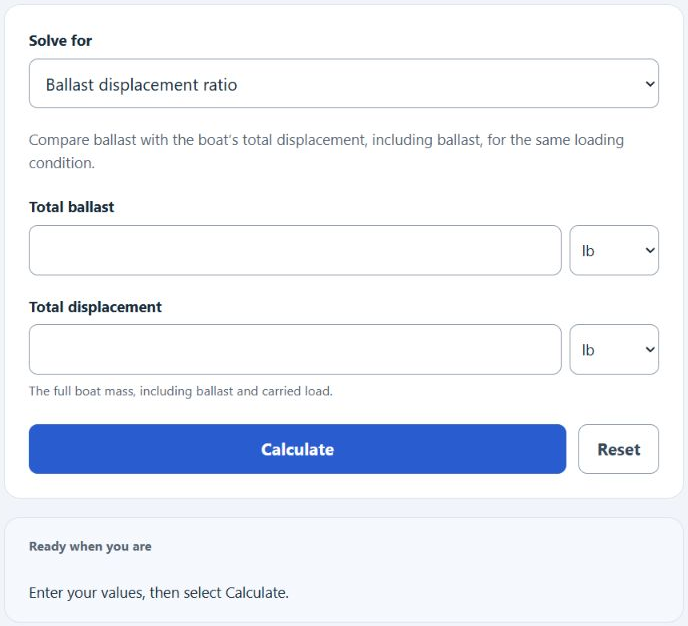
Calculate total ballast, total displacement, or ballast displacement ratio from any two values with support for lbs, kg, short tons, and metric tons.
- All Miscellaneous Calculators
- Ballast Weight Calculator
- Boat Gross Tonnage Calculator
- Boat Draft Calculator
Ballast Displacement Ratio Formula
The ballast displacement ratio compares the weight of a boat’s ballast to its total displacement. Enter ratios as decimals, not percentages (0.35 means 35%). Total displacement must be positive and include ballast; ballast cannot exceed displacement. Use the same loading condition for both figures.
- BDR = ballast displacement ratio, unitless
- TB = total ballast
- TD = total displacement
Select the value to solve for, then enter the other two:
- To find ballast displacement ratio: divide total ballast by total displacement.
- To find total ballast: multiply total displacement by the ballast displacement ratio.
- To find total displacement: divide total ballast by the ballast displacement ratio.
Total ballast and total displacement must use compatible weight units. The calculator converts pounds, kilograms, short tons, and metric tons internally before applying the formula.
Ballast Displacement Ratio Reference Values
Ballast displacement ratio is often shown as a decimal or as a percentage. The calculator shows both the decimal ratio and its percentage (decimal × 100).
| Decimal Ratio | Percent | Meaning |
|---|---|---|
| 0.20 | 20% | Ballast is 20% of total displacement. |
| 0.30 | 30% | Ballast is 30% of total displacement. |
| 0.40 | 40% | Ballast is 40% of total displacement. |
| 0.50 | 50% | Ballast is 50% of total displacement. |
| Unit | Equivalent in Pounds | Use in the Calculator |
|---|---|---|
| 1 lb | 1 lb | Base unit for internal calculation. |
| 1 kg | 2.2046 lb | Converted before calculating the ratio. |
| 1 short ton | 2,000 lb | Used for US ton measurements. |
| 1 metric ton | 2,204.6226 lb | Used for tonne measurements. |
Example Calculations
Example 1: Find the ballast displacement ratio
A sailboat has a total displacement of 12,000 lb and total ballast of 4,200 lb.
The ballast displacement ratio is 0.35, or 35%.
Example 2: Find total ballast
A boat has a total displacement of 8,000 kg and a ballast displacement ratio of 0.32.
The total ballast is 2,560 kg.
FAQ
Is ballast displacement ratio the same as ballast percentage?
They describe the same relationship, but the format is different. A ballast displacement ratio of 0.35 equals a ballast percentage of 35%. To convert a ratio to a percentage, multiply by 100.
Should total displacement include ballast?
Yes. Total displacement is the full weight of the boat as it displaces water, including hull, rig, equipment, ballast, tanks, and other carried weight depending on the displacement figure being used.
Does a higher ballast displacement ratio always mean a boat is more stable?
Not always. A higher ratio means more of the boat’s displacement is ballast, but stability also depends on hull shape, beam, ballast location, keel depth, center of gravity, and loading. The ratio is useful for comparison, but it is not a complete stability measurement.