Calculate ballast weight for tractors, race cars, and sailboats from implement load, minimum weight, or boat displacement and ratio.
- All Construction Calculators
- Gross Vehicle Weight Rating (GVWR) Calculator
- Power-to-Weight Ratio Calculator
- Weight Distribution Calculator
- Wheel Torque Calculator
- Engine kW to Wheel kW Calculator
- Trailer Load Capacity Calculator
Ballast Weight Formula
The following formula is a common rule-of-thumb to estimate the ballast to add (or remove) to reach a target operating weight. The target weight-per-horsepower factor varies by tractor type and application.
- Where BW is the ballast weight to add (lbs)
- C is the target total weight per horsepower (lb/hp). Typical starting ranges for field/drawbar work are about 110–130 (2WD), 85–110 (MFWD), and 75–95 (4WD/Articulated).
- HP is the tractor’s engine or PTO horsepower (hp)
- TW is the current tractor weight without the ballast you’re sizing (lbs)
To calculate the ballast weight, multiply the horsepower by your chosen target weight-per-horsepower factor (C), then subtract the current weight of the tractor (without the ballast you’re sizing).
What is a ballast weight?
Definition:
A ballast weight is something, typically a piece of metal or another solid block of material, that adds weight to a vehicle in order to alter the handling or performance of the vehicle.
In the case of a tractor, it's normally used to help provide better traction when moving.
How to calculate ballast weight?
Example Problem:
The following example outlines how to calculate a ballast weight for a tractor.
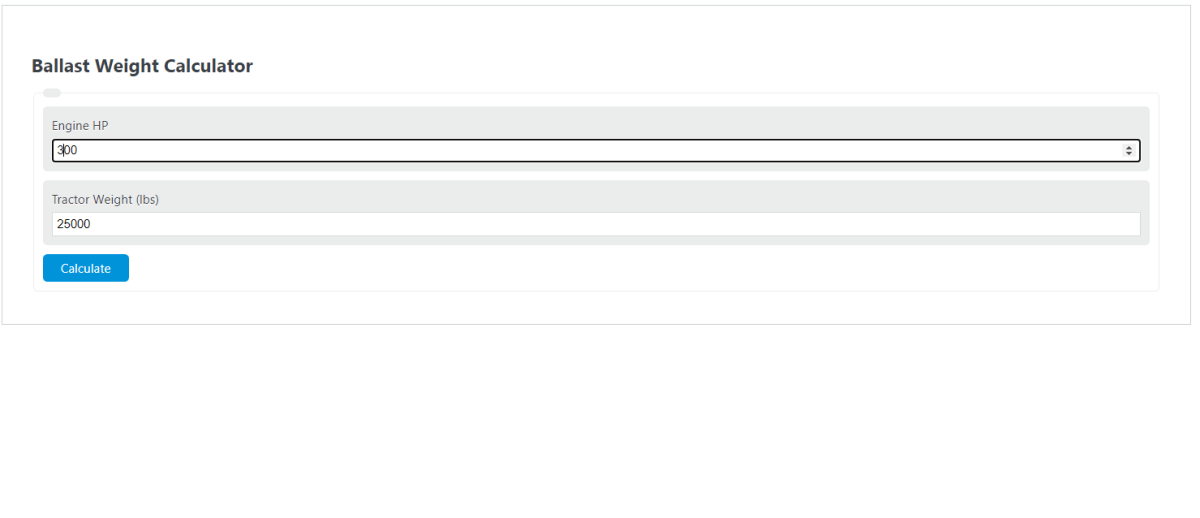
First, determine the total horsepower of the tractor. In this example, the tractor has a 300-horsepower engine.
Next, determine the current weight of the tractor. This tractor weighs 25,000 lbs.
Finally, calculate the ballast weight using the formula above (using an assumed target factor of C = 110 lb/hp):
BW = (C*HP) - TW
BW = (110*300) - 25000
BW = 8,000 lbs