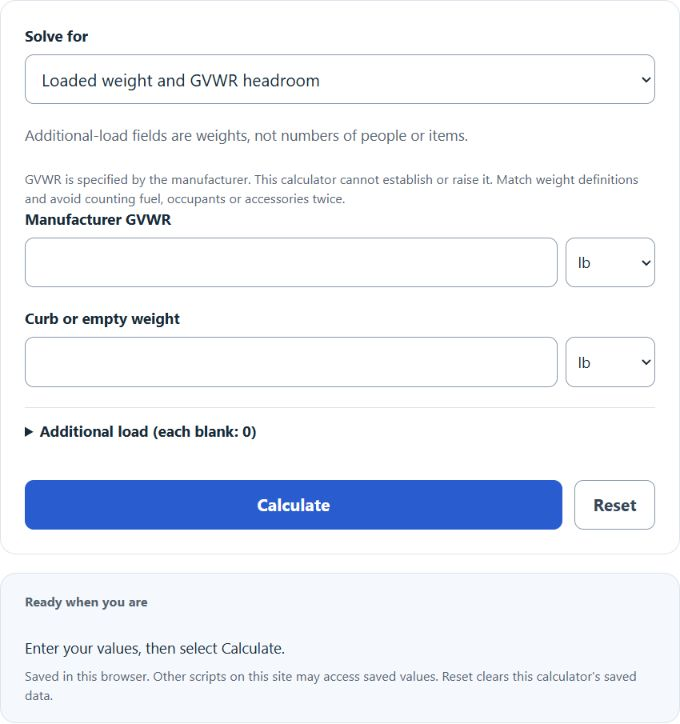
Calculate estimated loaded vehicle weight, headroom against the manufacturer’s GVWR, or a payload allowance on a consistent empty-weight basis. The tare-plus-rated-payload mode checks an arithmetic total; it cannot establish or raise an official rating.
- All Automotive Calculators
- Trailer Load Capacity Calculator
- Weight Distribution Calculator
- Trailer Tire Pressure Calculator
- Distance to Empty (DTE) Calculator
- Braking Torque Calculator
- Turning Radius Calculator
- Weight Transfer Calculator
- Wheel Over Point Calculator
GVWR Formula
GVWR is a manufacturer-specified loaded-weight rating. If tare and rated payload use a consistent documented basis, their sum can reproduce that stated rating; the identity below does not independently determine a safe rating.
- Where GVWR is the gross vehicle weight rating (lbs)
- TW is the vehicle's tare weight (lbs)
- RP is the rated payload of the vehicle (lbs)
To calculate actual loaded vehicle weight, add the empty vehicle and all loads carried by it. Do not substitute rated payload for actual load. Compare that total with the manufacturer’s GVWR and separately check other applicable ratings.
Tare, curb and unloaded weight definitions differ between specifications. Confirm fuel, equipment, occupant and accessory inclusion before combining figures; do not count the same load twice.
GVWR Definition
What is GVWR?
GVWR is the value specified by the manufacturer as the loaded weight of a single vehicle. Being below GVWR alone does not establish compliance with axle, tire, hitch, trailer or combined-weight limits.
Example Problem
How to calculate GVWR?
First, determine the tare weight of the vehicle. This is typically provided right from the manufacturer of the vehicle. For this example problem, the tare weight is determined to be 4000 lbs.
Next, use a documented rated-payload figure of1500lb on the same basis as the4000lb tare example. Their sum is5500lb; verify that arithmetic total against the vehicle’s official label. This example is not an independent certification of capacity.
Finally, calculate the GVWR using the formula above:
GVWR = TW + RP
GVWR = 4000 + 1500
GVWR = 5500 lbs