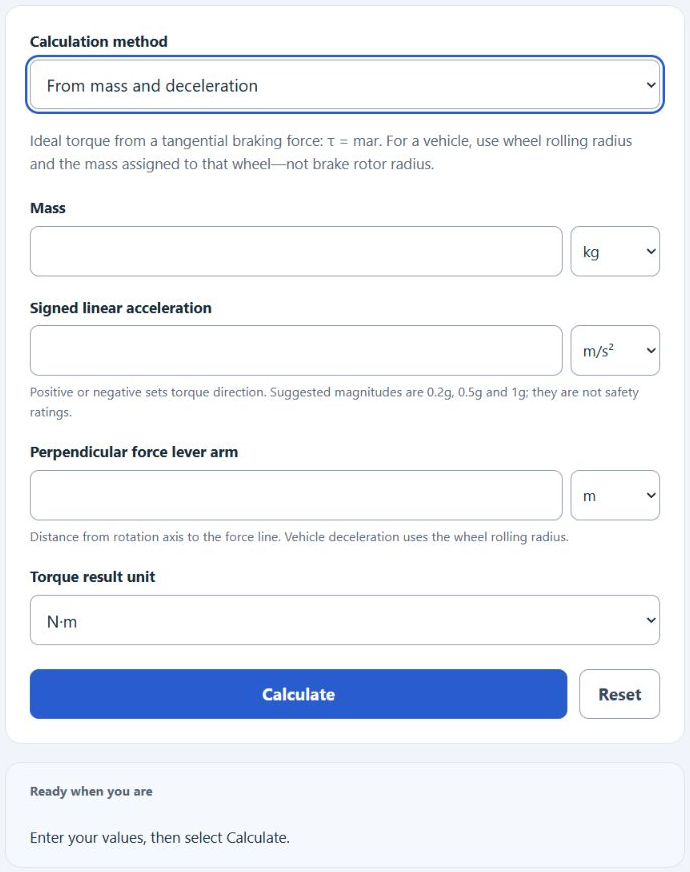
Calculate braking torque from mass, deceleration and radius, inertia and angular deceleration, or friction coefficient, normal force and radius.
- All Automotive Calculators
- Brake Caliper Clamping Force Calculator
- Braking Acceleration Calculator
- Braking Force Calculator
- Torque Calculator
- Net Torque Calculator
- Frictional Torque Calculator
Braking Torque Formula
Choose the method that matches your inputs. These are alternative ideal models, not torques to add together.
- τ is torque (N·m); its sign follows the chosen positive direction, except the friction method reports magnitude.
- m is mass (kg), a is signed linear acceleration (m/s²), and r is the perpendicular force lever arm (m).
- I is moment of inertia (kg·m²) and α is angular acceleration (rad/s²). The speed-change method uses α = (ωfinal − ωinitial) / t.
- μ is friction coefficient, N is normal force (N), and r is effective friction radius (m).
For vehicle deceleration, use wheel rolling radius and the mass assigned to that wheel, not rotor radius. Angular methods give net torque; other applied torques must be accounted for separately. For multiple friction interfaces, sum normal forces only when they share the same coefficient and effective radius. These estimates do not establish safe brake sizing.
How to Calculate Braking Torque?
The following example problems outline how to calculate Braking Torque.
Example Problem #1
- Select From mass and deceleration. Enter a mass of 1,000 kg.
- Enter signed linear acceleration of −4 m/s².
- Enter a perpendicular lever arm of 0.3 m.
- Select Calculate to find the corresponding torque:
τ = mar
Inserting the values from above and solving yields:
τ = 1,000 × (−4) × 0.3 = −1,200 N·m. The sign indicates direction; the magnitude is 1,200 N·m.
Example Problem #2
Select From inertia and angular acceleration for this example:
Moment of inertia = 5 kg·m²
Signed angular acceleration = −2 rad/s²
Equivalently, angular velocity falls from 20 rad/s to zero in 10 s.
Select Calculate to obtain net torque:
τ = Iα = 5 × (−2) = −10 N·m. In the friction method, μ = 0.4, N = 1,000 N and r = 0.15 m give a magnitude of 60 N·m.